LED series resistor calculator
The right resistor for one LED or a series string, with the nearest E24 value, color bands and power rating
A series resistor is the current-limiting resistor for one LED or a series string. An LED's forward voltage is almost constant over its operating range, so the resistor drops the excess voltage, and Ohm's law gives the resistance that sets the current you want: subtract the total forward voltage of the LEDs from the supply voltage and divide by the desired current, R = (Vs − n × Vf) ÷ If.
From any normal voltage supply, an LED without current limiting will overheat and fail. For standard 3 mm and 5 mm LEDs, usually rated 20 mA continuous, use one resistor per LED or per series string. This calculator finds the right value, picks the nearest standard E24 value, draws its color bands and checks the power rating. Everything runs in your browser.
Series resistor calculator
To choose an LED resistor, subtract the total forward voltage of the LEDs from the supply voltage and divide by the desired current: R = (Vs − n × Vf) ÷ If. This calculator does that, rounds up to the nearest standard E24 value, shows the color bands and checks the power rating.
Series resistor
R = (Vsupply − n × Vf) / If. Pick a color preset or enter datasheet values.
Standard 3 mm and 5 mm LEDs are usually rated 20 mA continuous. Use 5–10 mA for indicators: modern LEDs are bright, and lower current extends life.
How the calculation works
The resistor drops the excess voltage, so Ohm's law gives the value: a 3.0 V white LED at 20 mA on a 5 V supply needs (5 − 3.0) ÷ 0.020 = 100 Ω. The calculator rounds up to the next E24 value, recomputes the current and recommends a power rating twice the dissipation.
An LED's forward voltage is almost constant over its operating range, so the resistor drops the excess voltage. Ohm's law gives the resistance that sets the current you want. With n identical LEDs in series, their forward voltages add up. The calculator then rounds up to the next standard E24 (±5%) value so the current never exceeds your target, recomputes the actual current, and works out the heat in the resistor, P = I² × R. It recommends a rating at least twice that, because resistors run hot near their limit.
R = (5 − 3.0) / 0.020 = 100 Ω → E24: 100 Ω (brown · black · brown · gold)
P = 0.020² × 100 = 40 mW → a 1/8 W or 1/4 W resistor is plenty
Practical tips
Use one resistor per LED or per series string, never one shared resistor for parallel LEDs, because one LED will hog the current. Series strings waste less power, the longer anode lead goes to positive, and above about 350 mA a constant-current driver works better than any resistor.
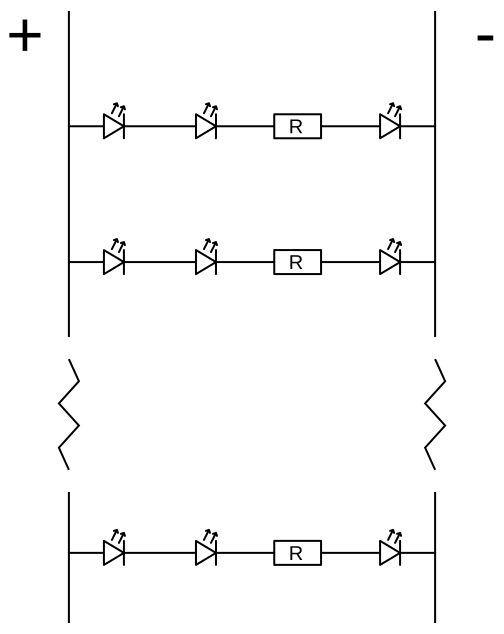

- One resistor per LED (or per series string). Never put LEDs in parallel on one shared resistor. Small Vf differences make one LED hog the current.
- Series is more efficient. On 12 V, three white LEDs in series (9 V) waste only 25% of the power in the resistor, while a single LED wastes 75%.
- Check polarity. The long lead (anode) goes to positive. Reverse voltage above ~5 V can damage an LED.
- Above ~350 mA, use a constant-current driver. Resistors regulate poorly as LEDs heat up, and waste too much power at high current (see LED drivers and flicker).
Typical forward voltage by color
Most LEDs run at a forward voltage set by their color: about 1.2–1.6 V for infrared, 1.8–2.2 V for red, 2.0–2.2 V for amber and yellow, and 2.8–3.4 V for green, blue and white at 20 mA. High-power LEDs at 350 mA and above run 0.2–0.5 V higher.
| Color | Wavelength | Material | Typical Vf |
|---|---|---|---|
| Infrared | 850–940 nm | GaAs / AlGaAs | 1.2–1.6 V |
| Red | 620–660 nm | AlInGaP / AlGaAs | 1.8–2.2 V |
| Orange / amber | 590–615 nm | AlInGaP | 2.0–2.2 V |
| Yellow | 585–595 nm | AlInGaP | 2.0–2.2 V |
| Green (InGaN) | 515–530 nm | InGaN | 2.8–3.4 V |
| Blue | 450–475 nm | InGaN | 2.8–3.3 V |
| White | Blue + phosphor | InGaN + YAG | 2.8–3.3 V |
| UV-A | 365–405 nm | InGaN / GaN | 3.0–3.9 V |
Frequently asked questions
How do I calculate the resistor for an LED?
R = (Vsupply − Vf × n) / If. A 3.0 V white LED at 20 mA on 5 V needs (5 − 3) / 0.02 = 100 Ω.
What resistor do I need for an LED on 12 V?
One red LED at 20 mA: (12 − 2) / 0.02 = 500 Ω, so use 510 Ω rated 1/2 W. Better: three white LEDs in series need only 150 Ω and waste far less power.
Can I run an LED without a resistor?
Only from a constant-current source, or a coin cell whose internal resistance limits current. From any normal voltage supply, an LED without current limiting will overheat and fail.
Sources and further reading
- IEC 60062:2016, Marking codes for resistors and capacitors (color code); IEC 60063:2015, Preferred number series for resistors and capacitors (E24 and other E series).
Cite this page
IEEE
LEDlights.org. "LED series resistor calculator." LEDlights.org. https://ledlights.org/tools/led-series-resistor-calculator/ (accessed Nov. 16, 2026).BibTeX
@misc{ledlights2026resistorcalculator,
  author       = {{LEDlights.org}},
  title        = {LED series resistor calculator},
  year         = {2026},
  month        = nov,
  howpublished = {\url{https://ledlights.org/tools/led-series-resistor-calculator/}},
  note         = {Accessed: 2026-11-16}
}
APA
LEDlights.org. (2026, November 16). LED series resistor calculator. https://ledlights.org/tools/led-series-resistor-calculator/
Markdown
[LED series resistor calculator](https://ledlights.org/tools/led-series-resistor-calculator/), LEDlights.org, updated November 16, 2026.