UV-C LED disinfection
Germicidal wavelengths, dose and log reduction, eye and skin limits, and how to check a product's claims
Standards-referenced • 17 cited sources
Limits and thresholds here are quoted from the standards and primary sources listed at the end. How pages are checked
Germicidal ultraviolet (GUV) is ultraviolet radiation, mainly UV-C between 200 and 280 nm, used to inactivate bacteria, viruses and other microorganisms by damaging their DNA and RNA. Low-pressure mercury lamps emit it at 253.7 nm; UV-C LEDs emit a single chosen wavelength, usually between 255 and 280 nm.
UV-C LEDs are sold in water purifiers, air cleaners, sanitizing boxes and handheld wands, with claims that are hard to check from the packaging. This guide explains how UV-C inactivates microbes, how dose and log reduction are measured, how LEDs compare with the mercury lamps they are starting to replace, and why the same light that disinfects is hazardous to eyes and skin. Every limit and threshold is quoted from the standard or agency that set it. It is not medical or infection-control advice. The LEDs themselves are described under ultraviolet LEDs.
How does UV-C light disinfect?
UV-C is absorbed by the DNA and RNA of bacteria, viruses and protozoa, and the damage stops them replicating, so they can no longer cause infection. Nucleic acids absorb most strongly near 260 nm, and the standard germicidal response curve peaks at about 265 nm, which is why UV-C LEDs are made for 255–280 nm.
The US Environmental Protection Agency's UV guidance manual puts the absorption of DNA and RNA between 200 and 300 nm, with a peak near 260 nm. The Illuminating Engineering Society (IES) describes the result as preventing replication, which leads to "the death of virtually all bacteria and inactivation of all viruses". The microbe is not necessarily destroyed. It is inactivated: it can no longer reproduce. The EPA manual also describes repair mechanisms in some microorganisms, known as photorepair and dark repair.
The standardized germicidal action spectrum in the IES Handbook, which is based on E. coli, runs from 235 to 313 nm and peaks at about 265 nm; the IES notes that spores, other bacteria and viruses can respond differently. The 253.7 nm line of a low-pressure mercury lamp falls close to that peak, and the International Commission on Illumination (CIE) notes that germicidal UV, "primarily 254 nm", has been used for more than 70 years. LEDs can be made for the peak itself.
Longer wavelengths are no substitute. The IES puts the disinfecting ability of UV-A and visible light at about 1,000 times less than that of a low-pressure mercury germicidal lamp, so a blacklight, an insect trap or a 365–405 nm curing LED does not do the job of a UV-C source.
Where germicidal sources sit in the ultraviolet
What UV dose does disinfection need?
UV dose is irradiance multiplied by time, in millijoules per square centimeter: 1 mW/cm² for 40 seconds delivers 40 mJ/cm². NSF/ANSI 55 requires 40 mJ/cm² for Class A water purifiers and 16 for Class B, and the IES cites 20 to 100 mJ/cm² for surfaces. Each added log of reduction removes another 90% of what remains.
Irradiance is the UV power arriving on each square centimeter of the target, not the power the LED emits. It falls quickly with distance and with anything in the way, so a dose claim means little without the distance and time at which it was measured. Results are reported as log reduction: 1 log is a 90% reduction in viable organisms, 2 log is 99%, 3 log is 99.9% and 4 log is 99.99%.
| Log reduction | Share inactivated | Cryptosporidium | Giardia | Viruses |
|---|---|---|---|---|
| 1 log | 90% | 2.5 | 2.1 | 58 |
| 2 log | 99% | 5.8 | 5.2 | 100 |
| 3 log | 99.9% | 12 | 11 | 143 |
| 4 log | 99.99% | 22 | 22 | 186 |
These are the doses, in mJ/cm², for which US public water systems receive treatment credit. The regulation states that they are for light at 254 nm from a low-pressure mercury lamp, applied to filtered water or to systems that meet the criteria for avoiding filtration; any other lamp type has to demonstrate an equivalent germicidal dose through validation testing. The table shows how much organisms differ. The two protozoa need little, while the virus credit needs many times more. Not every virus is that resistant: the foreword of NSF/ANSI 55 cites data showing a 3 to 4 log reduction of poliovirus and rotavirus at 30 mJ/cm².
For home and building water units, NSF/ANSI 55 sets two classes. Class A systems deliver 40 mJ/cm² and are meant to disinfect microbiologically unsafe water, covering bacteria, viruses, Cryptosporidium and Giardia. Class B systems deliver 16 mJ/cm² and are for supplemental treatment of water already considered safe. The 2019 edition added UV-C LED systems. Because LEDs do not emit at 254 nm, an LED system is judged by the reduction it achieves on a test virus, the Qβ coliphage, rather than by a calculated dose.
For surfaces, the IES says the dose "depends on the type of surface and its cleanliness" and gives recommended exposures of 20 to 100 mJ/cm² (200 to 1,000 J/m²).
UV-C LEDs compared with mercury lamps
A low-pressure mercury lamp turns about 30–45% of its input power into UV-C at 253.7 nm. The best commercial UV-C LEDs reach about 10%, and many only a few percent, with milliwatts per chip. LEDs are mercury-free, start instantly, make no ozone and can be built for a chosen wavelength.
| Property | Low-pressure mercury lamp | UV-C LED |
|---|---|---|
| Wavelength | 253.7 nm, fixed by the mercury discharge | Set by the AlGaN chip, about 255–280 nm; 265 and 275 nm are the most common |
| Input power emitted as UV-C | About 30–45% | Near 10% for the best commercial devices around 265 nm; often a few percent |
| Form | Glass discharge tube, like a fluorescent lamp | Small chip on a heat-sinked board, used in arrays |
| Warm-up | Needs time to reach full output | None |
| Mercury | Yes | None |
| Ozone | A second line at 184.9 nm makes ozone unless the lamp glass absorbs it | None at 255–280 nm |
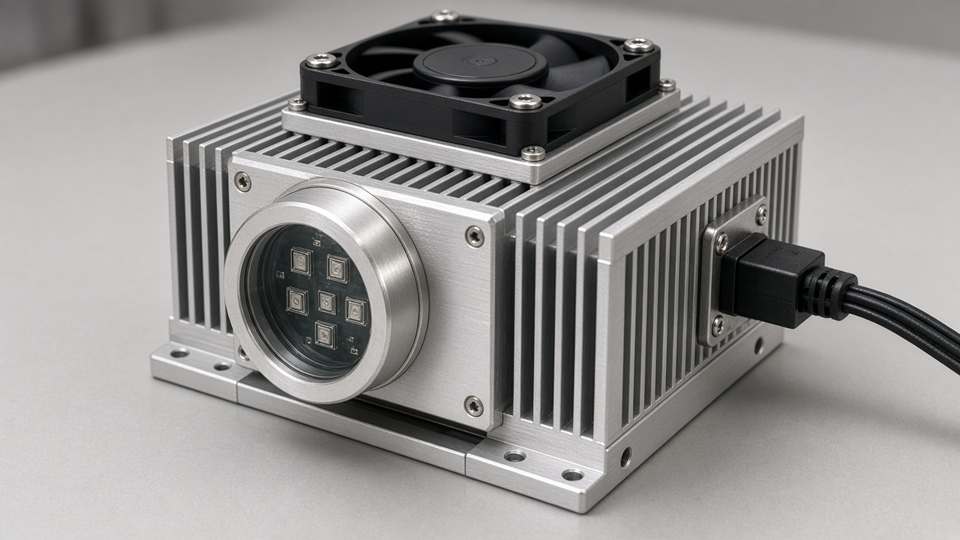
LED efficiency is low but rising. The 2020 UV emitter roadmap put the record for a commercial 280 nm LED at 6.4% external quantum efficiency and 4.1% wall-plug efficiency, with UV-B and UV-C LEDs emitting only 1 to 100 mW each. Its 2025 successor reports that the best commercial LEDs around 265 nm have reached a wall-plug efficiency near 10% and expects 20% by 2028, which it describes as comparable to low- and medium-pressure mercury lamps. Even at 10%, nine-tenths of the input power becomes heat in a small chip, which is why UV-C LED products need heat sinks and often fans. The chips also run at a higher forward voltage, about 5–7 V.
Lifetime is shorter than that of white LEDs. A 2022 reliability study from the University of Padova noted that manufacturers' datasheets indicated only "a few thousand hours" and found that reliability varied with the manufacturer. It concluded that, because a single treatment can take only a few minutes, the lifetime "may still be sufficient for thousands of operations", but that continuous use, as in water treatment plants, was "still not advisable". The 2025 roadmap reports L70 lifetimes above 10,000 hours for the best commercial devices. For comparison, white LEDs are typically rated at 25,000 hours or more (see LED lifespan and L70).
Two things are pushing the change despite the efficiency gap. LEDs suit jobs a tube does poorly: they reach full output at once, can be dimmed electronically and are small enough to build into compact point-of-use devices. And mercury lamps face regulation: the 2025 roadmap expects the Minamata Convention and the European RoHS Directive to restrict mercury UV lamps in the coming years.
Where UV-C LEDs work: water, air and surfaces
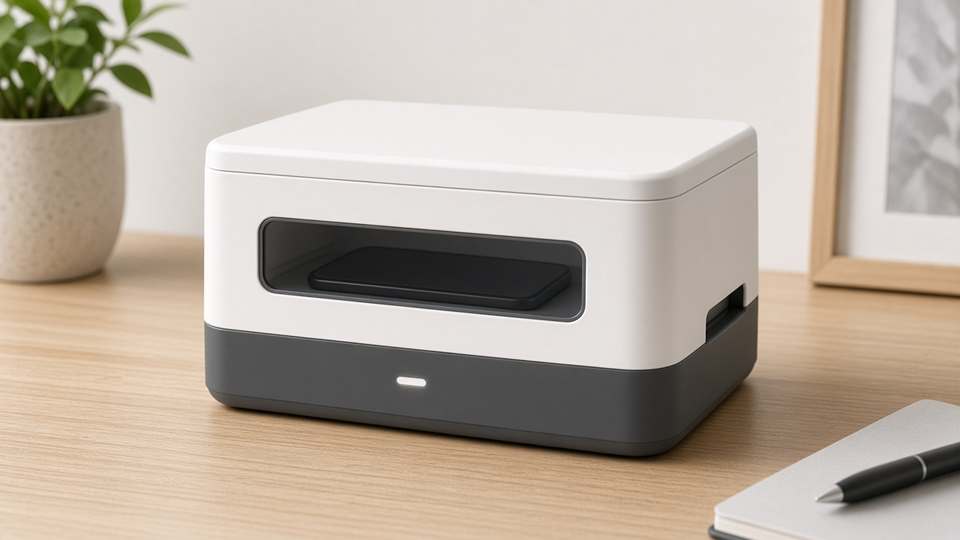
UV-C LEDs suit small, enclosed jobs best. In point-of-use water purifiers the light is sealed inside and can switch on only when water flows. Air is treated inside ducts or closed air cleaners. Surfaces are hardest: UV-C does not penetrate dirt or reach shadows, so the IES calls it a supplement to cleaning, not a replacement.
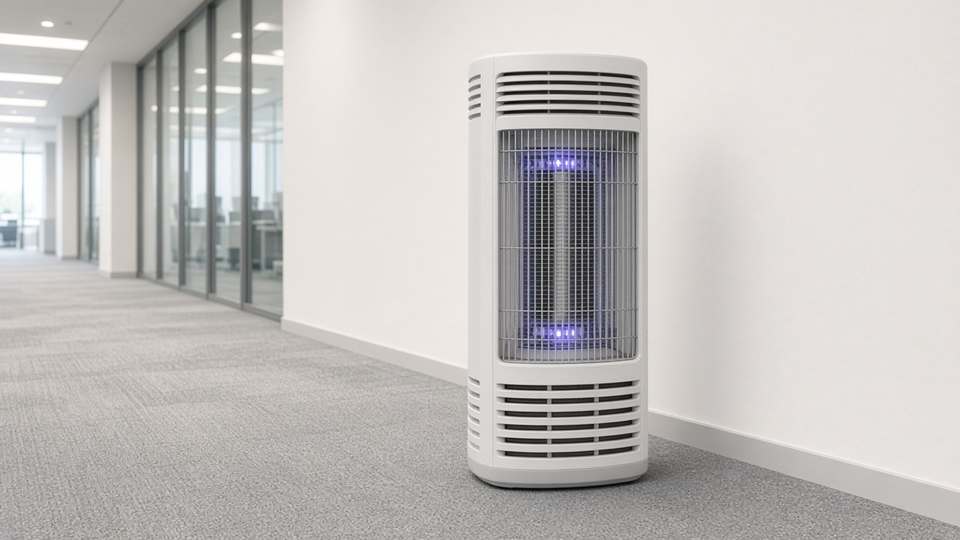
Water. This is where LEDs are best established, and where an independent performance standard exists. NSF/ANSI 55 covers point-of-use and point-of-entry systems that use UV between 240 and 300 nm. Its Class A systems are intended for water that is visually clear, "not colored, cloudy, or turbid", and the standard states that they do not reduce chemical or particulate contaminants, so UV is commonly paired with a filter. The EPA manual gives the reason clarity matters: the delivered dose depends on the UV intensity, the flow rate and the UV transmittance of the water. It also notes that UV, unlike a chemical disinfectant, leaves no residual in the water.
Air. According to the IES, germicidal UV is most effective for room air when it irradiates the upper part of the room, above head height, and it is also used in ventilation ducts and room air cleaners. These are still mostly mercury-lamp systems: in its 2020 report the IES noted that complete upper-air systems using LEDs were not yet on the market. Enclosed air cleaners and duct modules keep the UV-C away from people, which is the safeguard UL 8802 describes for contained equipment.
Surfaces. The IES calls UV-C "an excellent surface disinfectant" that nevertheless "does not penetrate surfaces and cannot disinfect soiled surfaces", and that cannot reach shadowed recesses or get through dust. It is therefore "typically used as a supplemental control measure". Handheld wands are the weakest case. The IES found that most emit less than 2 mW/cm² at contact, so the wand has to be held against the surface for several seconds, and that waving one over an object for one second "will not provide reliable disinfection". An enclosed chamber that switches off when opened avoids the exposure problem, although the dose reaching every side of the object still has to be shown by testing.
Is UV-C from LEDs safe for eyes and skin?
No. Direct UV-C exposure injures the cornea and skin. The ICNIRP limit for unprotected eyes and skin is 3 mJ/cm² in eight hours at 270 nm, the most hazardous wavelength and close to where UV-C LEDs emit. A source strong enough to disinfect in seconds exceeds that limit in a fraction of the time.
Never look at an operating UV-C LED and never use one on skin. UV-C itself is invisible, and the injury is not felt at the time: symptoms usually begin 6 to 12 hours later. Use UV-C only inside an enclosure, or in a space with nobody in it.
The most widely cited exposure limits come from the International Commission on Non-Ionizing Radiation Protection (ICNIRP). They apply to unprotected eyes and skin over an 8-hour period and are weighted by wavelength, with the greatest sensitivity at 270 nm. ICNIRP calls them "absolute limits" for the eye and "advisory" for skin, because skin sensitivity varies with skin type.
| Wavelength | Typical source | Limit in 8 h (mJ/cm²) | Relative hazard |
|---|---|---|---|
| 220 nm | Near the 222 nm excimer lamp line | 25 | 0.12 |
| 254 nm | Low-pressure mercury lamp | 6.0 | 0.50 |
| 260 nm | UV-C LED | 4.6 | 0.65 |
| 265 nm | UV-C LED | 3.7 | 0.81 |
| 270 nm | UV-C LED | 3.0 | 1.00 |
| 275 nm | UV-C LED | 3.1 | 0.96 |
| 280 nm | UV-C LED | 3.4 | 0.88 |
Two points follow from the table. First, per millijoule, light from a 265–280 nm LED is 1.6 to 2 times as hazardous to eyes and skin as light from a 254 nm mercury lamp. The IES makes the same point: UV-C LED devices emitting near 270 nm pose "a hazard to the cornea and skin". Second, the limit is far below any disinfecting dose. The table below compares the two, using the IES surface range of 20 to 100 mJ/cm².
| Irradiance at the target | Time to deliver 20 mJ/cm² | Time to deliver 100 mJ/cm² | Time to reach the 3 mJ/cm² limit |
|---|---|---|---|
| 0.1 mW/cm² | 3 min 20 s | 16 min 40 s | 30 s |
| 1 mW/cm² | 20 s | 1 min 40 s | 3 s |
| 2 mW/cm² | 10 s | 50 s | 1.5 s |
| 10 mW/cm² | 2 s | 10 s | 0.3 s |
The times are LEDlights.org's arithmetic from the dose formula, for 270 nm light reaching bare eyes or skin at the same irradiance as the target. Whatever the irradiance, the daily limit is reached in less than a sixth of the time needed for even the lowest surface dose. The US Food and Drug Administration reached the same conclusion from testing: "When a product is advertised to disinfect in seconds, it likely means that it gives off an unsafe level of UV-C radiation." It found that some handheld wands emitted, at about two inches, as much as 3,000 times the ICNIRP limit, enough to injure the user or a bystander "after a few seconds of exposure".
The injuries are burns to the surface tissues. In the eye it is photokeratitis, the "welder's flash": ICNIRP describes a sensation of sand in the eyes that usually begins 6 to 12 hours after exposure, lasts 6 to 24 hours and has usually gone within 48 hours, rarely leaving permanent damage. On skin it is erythema, a reddening like sunburn. The CIE considers the risk of skin cancer from devices that emit only UV-C to be negligible, but it and the World Health Organization warn against using UV lamps to disinfect hands or any other skin, and the CIE states that germicidal UV in the home "is not advisable". UV-C also degrades materials, plastics in particular.
Where people must work near an open source, the IES advice is a plastic or glass face shield, gloves and full-coverage clothing of tightly woven fabric, with warning signs at the entrances.
Is far-UVC at 222 nm available as an LED?
Not in practical form. Far-UVC at 222 nm comes from krypton-chloride excimer lamps. LEDs lose efficiency sharply at shorter wavelengths: devices below 240 nm reach just over 1% wall-plug efficiency, and research chips at 222 nm emit a fraction of a milliwatt. In 2022 ACGIH raised its 222 nm exposure limits well above those for 254 nm.
Far-UVC is of interest because radiation near 222 nm is strongly absorbed by proteins in the outermost layer of the skin, so less of it reaches living cells than at 254 nm. The American Conference of Governmental Industrial Hygienists (ACGIH) revised its threshold limit values in 2022: at 222 nm they are now 161 mJ/cm² for the eyes and 479 mJ/cm² for skin when the eyes are protected, against 6 mJ/cm² for the eyes at 254 nm. ICNIRP's 2004 guidelines give 25 mJ/cm² at 220 nm and 20 mJ/cm² at 225 nm. The evidence is still developing: the IES noted in 2020 that far-UVC lamps can pose a hazard to the cornea and that studies of the skin hazard were inconsistent, and the CIE called for more research on the safety of new UV-C sources.
The light source is a lamp, not an LED. A Fraunhofer review of the field at the end of 2023 called krypton-chloride (KrCl) excimer lamps the only sources able to generate 222 nm far-UVC in practice, at a wall-plug efficiency of 1–2%, and noted that they need filters to block their weaker emissions above 230 nm. LED efficiency falls steeply toward shorter wavelengths: the 2025 roadmap puts far-UVC LEDs below 240 nm at just over 1%, and the Ferdinand-Braun-Institut reported research chips emitting 10.7 mW at 233 nm but only 0.2 mW at 222 nm. A product described as a "222 nm LED" should come with a measured spectrum.
Who checks UV-C products and their claims?
Often nobody before sale. In the United States, UV lights sold with germicidal claims are pesticide devices: the EPA does not register them or routinely review their safety or efficacy, and an EPA establishment number only identifies the factory. Independent evidence comes from certification to standards such as NSF/ANSI 55, IEC 62471-6 and UL 8802.
The EPA regulates UV lights sold with claims to kill or control viruses, bacteria or other microorganisms as pesticide devices under the federal pesticide law, FIFRA. Unlike chemical disinfectants, devices are not registered and get no pre-market review. In the agency's words, "EPA does not routinely review the safety or efficacy of UV light devices" and so "cannot confirm whether, or under what circumstances, UV light devices might be effective". What the law does require is that the device be made in an EPA-registered establishment, carry that establishment number on its label, and make only claims that are true and not misleading. An establishment number is not an approval, and the EPA's rules treat any implication that a federal agency endorses a device as misbranding.
The FDA oversees UV products as radiation-emitting electronic products. In a 2022 safety communication it reported testing handheld UV wands, sending Notification of Defect letters to the makers of those that emitted unsafe levels, and it advised consumers not to use wands that lack safety instructions or information on the radiation they emit.
| Standard or rule | Applies to | What it covers |
|---|---|---|
| NSF/ANSI 55 | Point-of-use and point-of-entry UV water treatment, 240–300 nm, including LEDs since 2019 | Disinfection performance: Class A (40 mJ/cm²) and Class B (16 mJ/cm²), plus labeling and literature |
| IEC 62471-6:2022 | UV lamp products, including UV LED products | Optical radiation safety assessment, risk groups, user safety information and labeling |
| ISO 15858:2016 | UV-C devices in ducts, in the upper air of rooms and portable in-room units; not water products | Minimum human safety requirements; adopts 6 mJ/cm² at 254 nm for an 8-hour day |
| ANSI/CAN/UL 8802 | UV germicidal equipment and systems; not hand-held equipment | Safeguards against UV overexposure, such as mounting height, baffles, sensors and containment |
| US EPA, FIFRA | UV lights sold with germicidal claims | Registered establishment, label requirements and truthful claims; no review of safety or efficacy |
How to judge a UV-C LED product
Look for a stated wavelength between about 255 and 280 nm, the irradiance in mW/cm² at a stated distance, and a test report giving the log reduction for a named organism. Prefer enclosed or interlocked designs, check water units for NSF/ANSI 55 certification, and distrust open devices that promise disinfection in seconds.
- Wavelength. A germicidal LED states a peak wavelength in the UV-C range, typically 265 or 275 nm. "UV light" with a wavelength of 365–405 nm, or with none given, is UV-A. The CIE warns that consumers "might be buying products that do not actually emit UV-C", and a visible violet glow is not evidence of it.
- Irradiance and time. Multiply the stated irradiance at the working distance by the exposure time to get the dose, and compare it with the figures above. A wattage or a count of LEDs is not a dose.
- Test evidence. A claim such as "99.9%" should name the organism, the dose or exposure time, the distance and the laboratory. The EPA advises companies to keep the records and data that substantiate their claims, so it is reasonable to ask for them.
- Containment. The light should be inside a closed chamber, or the device should switch off when opened, tilted or approached. The FDA lists "the lack of any means to protect users" among the common features of the unsafe wands it tested.
- Certification. For water, look for certification to NSF/ANSI 55 and note the class. For other products, look for a photobiological safety assessment to IEC 62471-6. In the United States the label should carry an EPA establishment number, which shows where the device was made and nothing more.
- Service life. Ask for the rated life of the LED module and how the product signals that output has fallen, since a UV-C LED that has dimmed looks the same from outside.
Frequently asked questions
Do UV-C LEDs kill viruses and bacteria?
They inactivate them, provided the dose is high enough and the light reaches them directly. Dose is irradiance multiplied by time; organisms differ widely in the dose they need, and dirt or shadows block the light.
Can a blacklight or UV-A LED disinfect?
No. The IES puts UV-A and visible light at about 1,000 times less effective than a germicidal mercury lamp. LEDs at 365–405 nm are made for curing and fluorescence, not disinfection.
Do UV-C LEDs produce ozone?
Not at 255–280 nm. Ozone from germicidal mercury lamps comes from a second emission line at 184.9 nm, which most lamps block with their glass. LEDs emit a single band and have no such line.
Are UV-C wands safe to use at home?
The FDA advises against wands that emit unsafe levels or lack safety information; some it tested could injure eyes or skin within seconds. The CIE says germicidal UV in the home is not advisable. Enclosed devices avoid the exposure.
How long do UV-C LEDs last?
Less than white LEDs. A 2022 study noted datasheet lifetimes of a few thousand hours, and a 2025 review reports more than 10,000 hours to 70% output for the best commercial devices. That is ample for devices that run for minutes at a time.
Does a UV-C LED water purifier remove chemicals or lead?
No. UV inactivates microorganisms only. NSF/ANSI 55 states that Class A systems do not reduce chemical or particulate contaminants and are intended for visually clear water, so UV is normally combined with a filter.
Can you see UV-C light?
No. UV-C lies well below the wavelengths the eye can detect, so a visible violet or blue glow does not show that a device emits UV-C or how much. Only a stated wavelength and measured irradiance do.
Does UV-C cause skin cancer?
The CIE considers the risk of skin cancer from devices that emit only UV-C to be negligible. The established hazards are acute: painful inflammation of the cornea and sunburn-like reddening of the skin, hours after exposure.
Sources and further reading
- Illuminating Engineering Society, Photobiology Committee, IES CR-2-20-V1, Germicidal Ultraviolet (GUV): Frequently Asked Questions (2020).
- US Environmental Protection Agency, Ultraviolet Disinfection Guidance Manual for the Final Long Term 2 Enhanced Surface Water Treatment Rule, EPA 815-R-06-007 (November 2006); UV dose table in 40 CFR 141.720(d)(1).
- NSF/ANSI 55-2019, Ultraviolet Microbiological Water Treatment Systems: foreword, scope, and Class A and Class B requirements.
- Water Conditioning & Purification International, "LED UV Systems and NSF/ANSI 55 Update" (December 2019) and "Log-Reduction Requirements for LED UV Systems Under NSF/ANSI 55" (May 2021).
- ICNIRP, "Guidelines on limits of exposure to ultraviolet radiation of wavelengths between 180 nm and 400 nm (incoherent optical radiation)," Health Physics 87(2), 171–186 (2004).
- ACGIH, 2022 TLVs and BEIs: threshold limit values for ultraviolet radiation, including the revised limits at 222 nm.
- CIE, Position Statement on the Use of Ultraviolet (UV) Radiation to Manage the Risk of COVID-19 Transmission (May 2020).
- US Food and Drug Administration, "Do Not Use Ultraviolet (UV) Wands That Give Off Unsafe Levels of Radiation: FDA Safety Communication" (20 July 2022, updated 17 August 2023).
- US Environmental Protection Agency, compliance advisory "EPA Regulations About UV Lights that Claim to Kill or Be Effective Against Viruses and Bacteria" (October 2020), and "Pesticide Devices: A Guide for Consumers".
- IEC 62471-6:2022, Photobiological safety of lamps and lamp systems – Part 6: Ultraviolet lamp products.
- ISO 15858:2016, UV-C Devices – Safety information – Permissible human exposure.
- ANSI/CAN/UL 8802:2023, Ultraviolet (UV) Germicidal Equipment and Systems.
- H. Amano et al., "The 2020 UV emitter roadmap," Journal of Physics D: Applied Physics 53, 503001 (2020).
- R. Zhang et al., "The 2025 UV optoelectronics roadmap," Journal of Physics D: Applied Physics, accepted manuscript (2026), doi:10.1088/1361-6463/aeb031.
- M. Kneissl et al., "The emergence and prospects of deep-ultraviolet light-emitting diode technologies," Nature Photonics 13, 233–244 (2019).
- N. Trivellin et al., "Reliability of commercial UVC LEDs: 2022 state-of-the-art," Electronics 11(5), 728 (2022).
- Fraunhofer IOSB-AST, white paper "Far-UVC: potentials and weaknesses" (status at the end of 2023); Ferdinand-Braun-Institut, research news "Origin of the efficiency drop in far-UVC light emitting diodes".
Image credits
- Point-of-use water purifier, industrial UV-C LED module, enclosed air cleaner and phone sanitizing box: AI-generated illustrations for LEDlights.org. Ultraviolet band diagram: LEDlights.org.
Cite this page
IEEE
LEDlights.org. "UV-C LED disinfection." LEDlights.org. https://ledlights.org/guides/uv-c-led-disinfection/ (accessed Nov. 15, 2026).BibTeX
@misc{ledlights2026uvcguide,
  author       = {{LEDlights.org}},
  title        = {UV-C LED disinfection},
  year         = {2026},
  month        = nov,
  howpublished = {\url{https://ledlights.org/guides/uv-c-led-disinfection/}},
  note         = {Accessed: 2026-11-15}
}
APA
LEDlights.org. (2026, November 15). UV-C LED disinfection. https://ledlights.org/guides/uv-c-led-disinfection/
Markdown
[UV-C LED disinfection](https://ledlights.org/guides/uv-c-led-disinfection/), LEDlights.org, updated November 15, 2026.