LED drivers and flicker
The electronics that decide whether an LED is smooth, silent and dimmable
An LED driver is the power supply that converts mains AC, or a battery or DC bus, into the regulated power an LED needs. Because LED current rises steeply with voltage, the driver holds either the current constant (constant-current drivers) or the voltage constant (constant-voltage drivers, for strips and modules with their own current limiting).
The LED chip gets the attention, but the driver decides much of what you experience: whether a lamp flickers on camera, buzzes on a dimmer, glows faintly when switched off or dies after two years. This guide explains how drivers work, how LEDs are dimmed and controlled, and how flicker is measured and limited.
Why LEDs need a driver
An LED's current rises steeply with voltage and its forward voltage falls as it warms, so a fixed voltage can quickly overdrive it. A driver converts mains AC or battery power into a controlled DC current, rectifying, stepping down and regulating it so the LED stays bright, cool and stable.
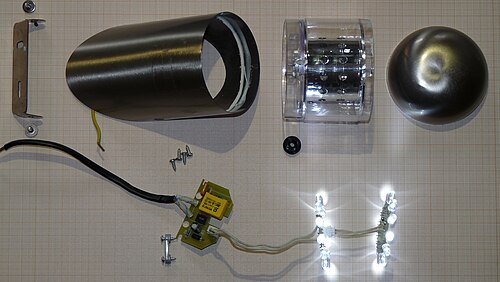

A white LED conducts almost nothing below about 2.5 V, yet a few tenths of a volt above its forward voltage can double its current. Worse, the forward voltage drops by roughly 2 mV per °C as the chip heats, so on a fixed-voltage supply a warm LED draws more current, heats further and can fail in thermal runaway. Connected straight to AC mains, an LED would also conduct on only half of each cycle, flicker at mains frequency and be destroyed by the peak voltage.
A driver therefore rectifies the AC, converts it to the right voltage, and regulates the current. In a retrofit bulb, the whole driver has to fit in the base and survive the heat of the LEDs; in professional fixtures it is usually a separate box, which makes it easier to cool and replace.
Constant current vs constant voltage
Constant-current drivers hold a fixed current, such as 350, 700 or 1,050 mA, and let the voltage float; they power LEDs wired in series, like COBs and downlights. Constant-voltage drivers hold a fixed 12, 24 or 48 V for strips and modules that have their own current limiting built in.
| Property | Constant current (CC) | Constant voltage (CV) |
|---|---|---|
| Regulates | Current (e.g. 350, 700, 1,050 mA) | Voltage (12, 24 or 48 V) |
| Output voltage | Floats within a window to suit the load (e.g. 9–42 V) | Fixed |
| LED wiring | LEDs in series | Strips or modules in parallel |
| Current limiting | In the driver | On the strip (resistors or ICs) |
| Typical loads | COBs, downlights, high-bays, streetlights, panels | LED strips, signage modules, cabinet lights |
| Sizing | Match current; LED string voltage inside the window | Match voltage; load at most 80% of rated watts |
| Classic mistake | Connecting a CV strip to a CC driver | Connecting bare LEDs without current limiting |
Never mix the two: a constant-current driver will push its full current through whatever is attached, and a constant-voltage supply will happily destroy a bare COB. For strips, choose 24 V or 48 V over 12 V on long runs, because the lower current means less voltage drop and more even brightness.
Inside a driver: linear, buck and flyback
Cheap linear drivers burn off excess voltage and often flicker. Buck converters step mains down efficiently and are common in bulbs, while isolated flyback drivers use a transformer for safety. The best drivers use two stages, power-factor correction followed by a DC-to-DC converter, for low ripple and flicker.
- Linear (driver-on-board): constant-current chips sit on the LED board and drop the difference between the rectified mains and the LED string voltage. They are tiny and cheap, but without a large smoothing capacitor the light pulses at twice the mains frequency.
- Buck: a non-isolated switch-mode converter that steps the rectified mains down to the LED string voltage. It is efficient and compact, and is used in most retrofit bulbs, where the LEDs are sealed inside the lamp.
- Flyback: uses a transformer to isolate the LED output from the mains, allowing touch-safe, low-voltage (Class 2 or SELV) outputs and good power factor.
- Two-stage: a power-factor-correction stage followed by a DC-to-DC converter gives the lowest ripple and flicker and the widest dimming range, at higher cost.
The component most likely to wear out is the electrolytic capacitor, whose life roughly halves for every 10 °C rise in temperature. That is why drivers rated with 105 °C capacitors, and fixtures that keep the driver cool, last longer.
Power factor, harmonics and inrush
Power factor measures how efficiently a driver draws current from the grid; 1.0 is ideal, cheap drivers manage 0.5–0.6 and quality drivers exceed 0.9 with total harmonic distortion under 20%. Many LED drivers also draw a brief inrush current at switch-on that can trip breakers or weld relay contacts.
A low power factor means the driver draws current in short, peaky gulps, which loads the wiring and the grid without doing useful work. EU ecodesign rules set minimum displacement factors that rise with lamp power, and commercial programs such as the DesignLights Consortium generally ask for a power factor of at least 0.9 and THD of no more than 20%. Inrush currents can reach tens of amps for a fraction of a millisecond as the input capacitors charge, so large installations limit the number of drivers per breaker or relay, or use drivers with inrush limiting.
How LEDs are dimmed: PWM and CCR
Drivers dim LEDs in two ways. Pulse-width modulation switches full current on and off rapidly and varies the on-time, keeping color constant but risking flicker at low frequencies. Constant-current reduction lowers the current itself, which is flicker-free but can shift color and lose control at very low levels.
With PWM, a 25% duty cycle gives roughly 25% light. The frequency is what matters for comfort: at a few hundred hertz, deep modulation can be seen as stroboscopic effects and can bother sensitive people, while above about 3 kHz IEEE 1789 treats PWM as low risk at any depth. With constant-current reduction (CCR), also called analog dimming, the LED runs continuously at a lower current. Many quality drivers combine the two, using CCR down to 10–20% and then high-frequency PWM for smooth dimming to 1% or below.
Dimming controls: TRIAC, ELV, 0–10 V, DALI and DMX
Homes mostly dim with phase-cut wall dimmers, either leading-edge TRIAC or gentler trailing-edge ELV types. Commercial buildings use 0–10 V analog control or digital DALI, which addresses up to 64 drivers per line. Stage and façade lighting runs on DMX512, and smart homes increasingly use wireless protocols.
| Method | How it works | Wiring | Typical use | Watch out for |
|---|---|---|---|---|
| Leading-edge (TRIAC) | Cuts the start of each AC half-cycle | Existing 2-wire dimmers | Retrofit bulbs in homes | Minimum load, flicker, buzzing, limited range |
| Trailing-edge (ELV) | Cuts the end of each half-cycle, gentler on electronics | 2-wire; some need a neutral | LED bulbs and fixtures, Europe | Still needs a compatible driver |
| 0–10 V (1–10 V) | Low-voltage DC signal sets the level | Two extra control wires | Panels, troffers, high-bays | No addressing; separate switching |
| DALI / DALI-2 | Digital bus, 64 addresses and 16 groups per line (IEC 62386) | 2-wire bus, polarity-free | Offices, hospitals, emergency lighting | Needs commissioning |
| DMX512 / RDM | 512 channels per universe at 250 kbit/s | Shielded twisted pair (RS-485) | Stage, façades, RGB and pixel lighting | Termination and addressing |
| Wireless | Zigbee, Bluetooth Mesh, Thread/Matter, Casambi | None beyond power | Smart homes, retrofits | Standby power, interoperability |
Phase-cut compatibility between dimmers and LED lamps is the most common source of trouble in homes. The NEMA SSL 7A standard defines how compatible dimmers and lamps should behave; in practice, check the lamp maker's tested dimmer list.
What is LED flicker?
Flicker, or temporal light modulation, is a rapid repeated change in light output, usually from mains ripple at 100 or 120 Hz or from low-frequency PWM dimming. Even when invisible, it can cause headaches, eyestrain, stroboscopic effects on moving objects and banding in camera footage.
Most people see flicker directly only below about 80 Hz. Above that, modulation can still show up as the stroboscopic effect, where moving or spinning objects appear to stutter or stand still, and as the phantom array, a trail of dots seen when the eyes sweep past a light. IEEE 1789 links low-frequency, deep modulation to headaches, eyestrain and reduced visual performance, and flashing between about 3 and 70 Hz to seizure risk in people with photosensitive epilepsy. Incandescent lamps barely flicker because the filament stays hot; LEDs follow their current almost instantly, so the driver must smooth it.
Measuring flicker: percent flicker, Pst LM and SVM
Percent flicker compares maximum and minimum light output; IEEE 1789 rates it low-risk below 0.08 times the frequency, about 9.6% at 120 Hz. The EU instead uses Pst LM for visible flicker and SVM for stroboscopic effects, requiring Pst LM of 1.0 or less and, since September 2024, SVM of 0.4 or less.
| Metric | What it measures | Good values | Where it is used |
|---|---|---|---|
| Percent flicker | (max − min) ÷ (max + min) × 100 | Low risk ≤ 0.08 × frequency (9.6% at 120 Hz); no observable effect ≤ 0.0333 × frequency (4% at 120 Hz) | IEEE 1789 (90 Hz to 1.25 kHz; above 3 kHz exempt) |
| Flicker index | Area above the mean ÷ total area of one cycle | Lower is better; accounts for waveform shape | Older IES and ENERGY STAR reporting |
| Pst LM | Visibility of direct flicker (below ~80 Hz); 1.0 = noticed by half of observers | ≤ 1.0 | EU Regulation 2019/2020, since September 2021 |
| SVM | Visibility of the stroboscopic effect (80 Hz–2 kHz) | ≤ 0.4 (≤ 0.9 from 2021 to 2024) | EU Regulation 2019/2020, since September 2024 |
| JA8 modulation | Percent amplitude modulation at full and 20% output | < 30% below 200 Hz | California Title 24, JA8 |
A phone camera's slow-motion mode or a fast shutter speed is a rough test: dark bands rolling across the image reveal strong modulation. For real numbers, a flicker meter or spectrometer with a fast photodiode measures the waveform and calculates these metrics.
How to avoid flicker, buzzing and ghosting
Buy lamps and drivers that publish flicker data, pair them with LED-rated trailing-edge dimmers from the maker's compatibility list, and set the dimmer's low-end trim. Avoid mixing bulb brands on one dimmer. A faint glow when off usually comes from leakage current and is cured with a neutral-wired dimmer or load correction device.
- Flicker: choose products stating "flicker-free", percent flicker under about 10% at 120 Hz, or SVM ≤ 0.4. Professional drivers often quote PWM frequencies of several kilohertz or more.
- Dimming problems: drop-out, popping on and shimmer at low levels usually mean the dimmer's minimum load is not met or the dimmer and lamp are incompatible.
- Buzzing: comes from the dimmer's switching or the driver's magnetics. Trailing-edge dimmers are usually quieter.
- Ghosting: illuminated switches, smart dimmers without a neutral and long parallel cable runs can leak enough current to make LEDs glow or blink when off. A dimmer with a neutral connection or a small load-correction device fixes it.
Frequently asked questions
Why do LEDs need a driver instead of plugging straight into AC?
LEDs need low-voltage DC at a controlled current. On raw AC they would conduct only half of each cycle, flicker at mains frequency and be overdriven by the peak voltage. The driver rectifies, converts and regulates the power.
Can I power a COB with a constant-voltage supply?
Only if the module has its own current limiting. Bare COBs and LED strings need a constant-current driver matched to their current and voltage.
Why do my LEDs flicker on a dimmer?
Usually an incompatible dimmer and lamp, a dimmer whose minimum load is not met, or mixed bulb brands. Use an LED-rated trailing-edge dimmer from the lamp maker's compatibility list and adjust its low-end trim.
Is PWM dimming bad for your eyes?
Low-frequency PWM with deep modulation can cause eyestrain, headaches and stroboscopic effects in sensitive people. PWM above about 3 kHz, or constant-current dimming, avoids the problem.
What is a good flicker percentage?
Under IEEE 1789, 4% or less at 120 Hz has no observable effect and up to 9.6% is low risk. EU products must meet SVM ≤ 0.4 and Pst LM ≤ 1.0.
Sources and further reading
- IEEE Std 1789-2015, IEEE Recommended Practices for Modulating Current in High-Brightness LEDs for Mitigating Health Risks to Viewers.
- Commission Regulation (EU) 2019/2020 laying down ecodesign requirements for light sources and separate control gear, as amended by Regulation (EU) 2021/341.
- CIE TN 006:2016, Visual Aspects of Time-Modulated Lighting Systems: Definitions and Measurement Models; IEC TR 61547-1:2020 (light flickermeter).
- NEMA SSL 7A-2015, Phase-Cut Dimming for Solid State Lighting: Basic Compatibility.
- IEC 62386, Digital addressable lighting interface (DALI); ANSI E1.11 (DMX512-A) and ANSI E1.20 (RDM).
- California Energy Commission, Building Energy Efficiency Standards, Joint Appendix JA8.
- U.S. DOE Solid-State Lighting Program, reports on LED driver reliability and flicker.
Image credits
- LED driver close-up: bengt-re from Sweden, CC BY 2.0. Disassembled LED lamp: Dmitry G, CC BY-SA 3.0. Both via Wikimedia Commons.