SMD 2835 vs 5050 vs 3030
The surface-mount LED packages you will meet most often, compared at true scale
A surface-mount device (SMD) LED is an LED die in a small rectangular package that is soldered flat onto a circuit board instead of through holes. Its four-digit name, such as 2835, 3030 or 5050, gives the package footprint in tenths of a millimetre, not its power, brightness or quality.
Shop for an LED strip, panel or bulb and the same few numbers appear again and again. This guide explains what each package physically is, how much power and light it handles, how heat leaves it, and which one to choose for strips, bulbs, panels, grow lights and color-changing projects. The interactive diagram draws all five at true relative scale, with their thermal pads.
What the numbers mean
An SMD LED's four-digit name is its footprint in tenths of a millimetre: a 2835 measures 2.8 × 3.5 mm, a 3030 is 3.0 × 3.0 mm and a 5050 is 5.0 × 5.0 mm. The name says nothing about power, brightness, color quality or who made the chip inside.
The code is an industry convention, not a standard, and it leaves out the height (typically 0.6–1.9 mm). Two LEDs sold as "2835" can differ fivefold in rated power, from 0.2 W to 1 W, and enormously in efficacy, color consistency and lifetime. The 3528 and 2835 even share the same footprint, rotated, yet are completely different inside: the older 3528 is a tall plastic package with small leads, while the 2835 is thin and sits on a large thermal pad.
Side-by-side specifications
For white light, 2835 and 3030 packages are the most efficient, at roughly 120–220 lumens per watt, because a large thermal pad pulls heat into the board. 5050 packages hold three dies and suit RGB. 3528 and 5630 are older designs that are now mostly found in budget strips and panels.
| Package | Size (mm) | Dies | Typical power | White efficacy | Heat path | Best for |
|---|---|---|---|---|---|---|
| 3528 | 3.5 × 2.8 | 1 | 0.06–0.1 W (20 mA) | 60–100 lm/W | Small leads; plastic body | Low-output strips, backlights |
| 2835 | 2.8 × 3.5 | 1–2 | 0.2–1 W (60–300 mA) | 120–220 lm/W | Large exposed thermal pad | Bulbs, tubes, panels, white strips |
| 3030 | 3.0 × 3.0 | 1 | 0.2–2 W (65–600 mA) | 150–220 lm/W | Thermal pad; heat-resistant EMC body | High-bays, streetlights, grow lights |
| 5050 | 5.0 × 5.0 | 3 | 0.2–0.3 W (3 × 20 mA) | 70–110 lm/W | Three lead pairs; plastic body | RGB, RGBW and addressable strips |
| 5630 / 5730 | 5.6–5.7 × 3.0 | 1 | 0.5 W (100–150 mA) | 100–150 lm/W | Thermal pad | Panels, troffers, tubes, corn bulbs |
Interactive diagram: SMD LED footprints drawn to scale, with thermal pads
SMD 2835: the efficient white workhorse
The 2835 is the workhorse of white LED lighting. It packs one or two dies above a large exposed thermal pad, runs at 0.2 to 1 watt, and reaches 120–220 lumens per watt in good versions. It dominates LED bulbs, tubes, panels and efficient white strips, including high-CRI grades.
Typical variants are rated 0.2 W (about 60 mA at 3 V), 0.5 W (about 150 mA) and 1 W, plus high-voltage versions with two or more dies in series (6 V, 9 V or 18 V) that let a bulb driver run more efficiently. Because the package is thin and sits almost entirely on its pad, heat travels a very short distance into the board's copper. The Samsung LM281B+ and the Lumileds LUXEON 2835 line are well-known examples, and high-CRI 2835s (Ra 90–97, R9 above 50) are widely available for homes and retail.
SMD 3030: square, robust and efficient
The 3030 is a square, 3 × 3 mm mid-power package, usually molded from heat-resistant EMC rather than plastic. It tolerates higher current and temperature than a 2835, so it is the usual choice for high-bays, streetlights and horticulture boards, where efficiency and long life matter most.
EMC (epoxy molding compound) resists the yellowing that degrades cheaper PPA plastic housings at high temperature and under intense blue light. Run gently, at about 65 mA, a top 3030 such as the Samsung LM301B or LM301H reaches around 200–220 lm/W, which is why it appears on so many high-efficiency horticulture "quantum boards". Run hard, other 3030s deliver 1–2 W each for compact high-bays and street luminaires. The Nichia NF2W757 and Lumileds LUXEON 3030 2D are other common examples.
SMD 5050: three dies for color
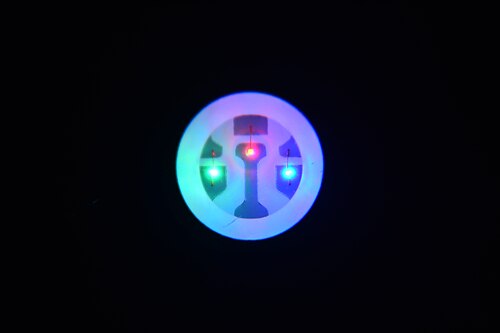
A 5050 is a 5 × 5 mm package with three separate dies, each normally driven at about 20 mA. Fitted with red, green and blue dies it is the standard RGB LED, and with a built-in controller it becomes the WS2812B. White 5050s are less efficient than 2835s.
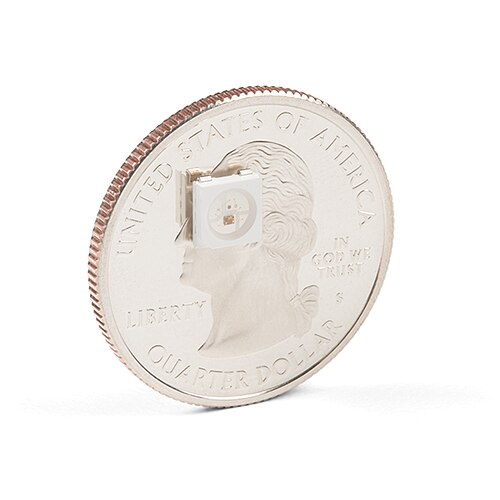

A classic 5050 has six pads, one anode and one cathode per die, so the dies can be wired separately for color mixing or in parallel for white. White 5050s put three blue dies under phosphor; they are bright per package but older in design, with a plastic body and no large thermal pad, so they reach only 70–110 lm/W. Addressable 5050s such as the WS2812B and SK6812 add a tiny controller chip and reduce the pins to four: power, ground, data in and data out.
3528, 5630 and other packages
The 3528 was the original strip LED of the 2000s: low power, around 0.06–0.1 watt, with no large thermal pad. The 5630 and 5730 are rectangular 0.5 watt chips that were popular in early panels and corn bulbs. Both have largely given way to 2835 and 3030 packages.
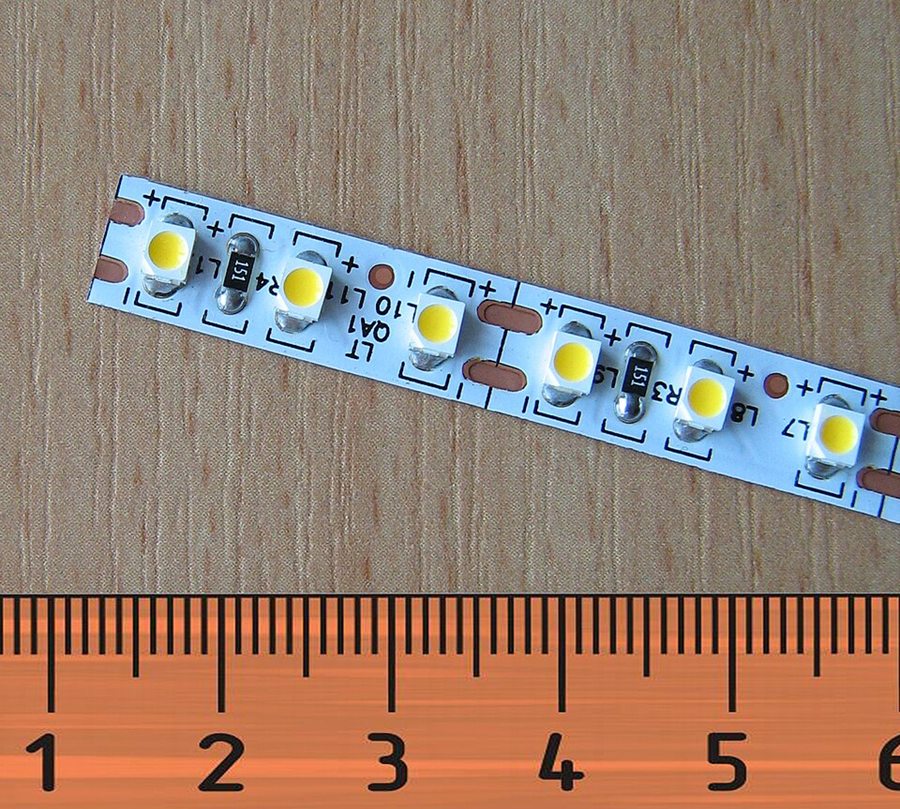

On a 12 V strip, three white 3528s in series drop about 9.3 V, and the 150 Ω resistor sets the current from the remaining 2.7 V: (12 − 9.3) ÷ 150 ≈ 18 mA, just under the package's 20 mA rating. The same arithmetic, for any supply and LED, is what the resistor calculator does.
Quality in the 5630/5730 class varied widely, and many budget products overdrove them, causing rapid lumen loss. Other sizes appear in specialist roles: the narrow 3014 (3.0 × 1.4 mm) for dense strips and edge-lit backlights, 4014 for panels, and tiny 2016 or 1616 packages for compact modules. Larger ceramic "high-power" packages such as 3535 and 5050-size XHP parts belong to a different class, covered under high-power LEDs.
Thermal pads and why they matter
A thermal pad is a metal area under the LED die that conducts heat straight into the circuit board's copper. Lower junction temperature means more light, stable color and longer life, so a package with a large pad can be driven harder and still outlast one without.
Heat flows from the die through its attach layer into the lead frame or pad, through solder into the board's copper, across the dielectric of an aluminium-core board (MCPCB), and finally into a heat sink and the air. Every layer adds thermal resistance. White LEDs typically lose about 10–15% of their light between a 25 °C and an 85 °C junction, and their lifetime falls steeply as the junction gets hotter (see LED lifespan). Switch on the thermal-pad overlay in the diagram above to compare packages: the 3528 and 5050 rely on their leads, while the 2835, 3030 and 5630 have a dedicated path for heat.
Which chip for LED strips?
For white LED strips, choose 2835 chips at 120 or more per metre, ideally 24 V and CRI 90+. Choose 5050 for RGB or RGBW color, addressable 5050 for effects, and dotless COB strips where the strip is visible or reflected in glossy surfaces.
| Strip type | LEDs per metre | Power per metre | Typical output | Notes |
|---|---|---|---|---|
| 3528 white | 60 / 120 | 4.8 / 9.6 W | 300–800 lm/m | Low-cost accent; older designs |
| 2835 white | 60–240 | 6–20 W | 600–2,200 lm/m | Best efficacy and CRI options |
| 5050 white | 30 / 60 | 7.2 / 14.4 W | 500–1,400 lm/m | Bright, less efficient |
| 5050 RGB | 30 / 60 | 7.2 / 14.4 W | 200–600 lm/m (all on) | Color mixing; poor whites |
| WS2812B (5 V) | 30 / 60 / 144 | 9 / 18 / 43 W at full white | — | Pixel effects; inject power every 1–2 m |
| COB (dotless) | 320–528 dies | 8–15 W | 800–1,500 lm/m | No visible dots; runs warm |

Whatever the chip, mount strips in an aluminium channel to carry heat away, keep the power supply at 80% load or less, and prefer 24 V over 12 V for runs longer than about 5 m to reduce voltage drop. Look for strips that name the LED maker and state lumens per metre, CRI and R9, rather than just "SMD 2835".
Cheap strips save money by using fewer, harder-driven LEDs, thin copper traces and unbranded chips. The result is visible hot spots, color shift along the run and early dimming. A slightly more expensive strip with more LEDs per metre, each running gently, is brighter for longer and more efficient.
Which one should you choose?
Pick the package by job, not by number. Use 2835 for bulbs, tubes, panels and white strips; 3030 for high-power fixtures and grow lights; 5050 for RGB and addressable effects. When one tight beam or a single shadow matters, skip SMD and use a COB or high-power LED.
- Bulbs, tubes, panels and white strips: 2835, from a named LED maker, with CRI 90+ for homes.
- High-bays, streetlights and grow lights: 3030 EMC packages such as the Samsung LM301B or LM301H.
- Color-changing and pixel effects: 5050 RGB, RGBW or addressable (WS2812B, SK6812).
- One crisp beam or a single shadow: not SMD at all; see COB vs SMD vs CSP.
Frequently asked questions
Is 2835 brighter than 5050?
Per watt, yes: a good 2835 makes 120–220 lumens per watt against 70–110 for a white 5050. Per package, a 0.2 W 2835 and a 5050 are similar, while 0.5 W and 1 W 2835s are brighter.
Can I replace a 3528 strip with a 2835 strip?
Usually, if the voltage matches. 2835 strips often draw more power per metre, so check that the power supply and controller can handle the extra current.
Why do 5050 LEDs have six pads?
Each of the three dies has its own anode and cathode, so the dies can be driven separately (RGB) or together (white). Addressable 5050s such as the WS2812B have four pins instead.
Is 3030 better than 2835?
Not automatically. 3030 EMC packages tolerate more current and heat, which suits high-power fixtures and grow lights, while 2835 is cheaper and ideal for bulbs, panels and strips. The maker matters more than the package.
What does "0.5 W 2835" mean?
The intended drive power: about 150 mA at roughly 3 V. A 0.2 W part runs at about 60 mA. Overdriving a low-power package shortens its life.
Sources and further reading
- Manufacturer datasheets: Samsung LM281B+, LM301B and LM301H; Lumileds LUXEON 2835 and LUXEON 3030 2D; Nichia NF2W757; Worldsemi WS2812B.
- IES LM-80-20, Approved Method: Measuring Luminous Flux and Color Maintenance of LED Packages, Arrays, and Modules, Illuminating Engineering Society (IES).
- ANSI C78.377-2017, Specifications for the Chromaticity of Solid-State Lighting Products.
- IEC 62031:2018, LED modules for general lighting: Safety specifications.
- U.S. DOE, "Solid-State Lighting R&D Opportunities" (2022), LED package efficacy and packaging trends.
Image credits
- SMD strip comparison: BrentMauriello, CC BY-SA 4.0. SMD 3528 strip: Andrey Gvrv, CC BY-SA 3.0. WS2812B on a quarter: SparkFun Electronics, CC BY 2.0. RGB 5050 macro: Akbermamps, CC BY 4.0. All via Wikimedia Commons. Diagram: LEDlights.org.