LED calculators and tools
Practical calculators for builders, buyers and engineers. Everything runs in your browser.
The series resistor calculator finds the right current-limiting resistor for one LED or a string, picks the nearest standard E24 value, draws its color bands and checks the power rating. The energy savings calculator converts incandescent, halogen or CFL bulbs, or metal-halide, high-pressure sodium and fluorescent fixtures, into equivalent LED lumens and watts and estimates kWh, dollars and CO₂ saved per year, with payback and ROI for commercial retrofits. Both can copy their results, share a link with your values and print a spec sheet.
LED series resistor calculator
To choose an LED resistor, subtract the total forward voltage of the LEDs from the supply voltage and divide by the desired current: R = (Vs − n × Vf) ÷ If. This calculator does that, rounds up to the nearest standard E24 value, shows the color bands and checks the power rating.
Series resistor
R = (Vsupply − n × Vf) / If. Pick a color preset or enter datasheet values.
Standard 3 mm and 5 mm LEDs are usually rated 20 mA continuous. Use 5–10 mA for indicators: modern LEDs are bright, and lower current extends life.
How the calculation works
The resistor drops the excess voltage, so Ohm's law gives the value: a 3.0 V white LED at 20 mA on a 5 V supply needs (5 − 3.0) ÷ 0.020 = 100 Ω. The calculator rounds up to the next E24 value, recomputes the current and recommends a power rating twice the dissipation.
An LED's forward voltage is almost constant over its operating range, so the resistor drops the excess voltage. Ohm's law gives the resistance that sets the current you want. With n identical LEDs in series, their forward voltages add up. The calculator then rounds up to the next standard E24 (±5%) value so the current never exceeds your target, recomputes the actual current, and works out the heat in the resistor, P = I² × R. It recommends a rating at least twice that, because resistors run hot near their limit.
R = (5 − 3.0) / 0.020 = 100 Ω → E24: 100 Ω (brown · black · brown · gold)
P = 0.020² × 100 = 40 mW → a 1/8 W or 1/4 W resistor is plenty
Practical tips
Use one resistor per LED or per series string, never one shared resistor for parallel LEDs, because one LED will hog the current. Series strings waste less power, the longer anode lead goes to positive, and above about 350 mA a constant-current driver works better than any resistor.
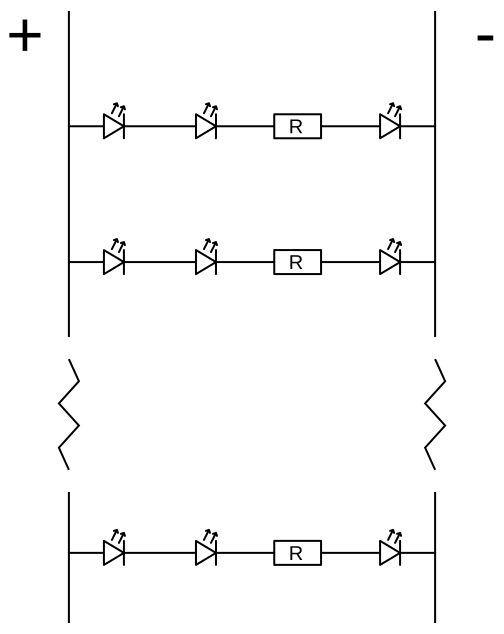

- One resistor per LED (or per series string). Never put LEDs in parallel on one shared resistor. Small Vf differences make one LED hog the current.
- Series is more efficient. On 12 V, three white LEDs in series (9 V) waste only 25% of the power in the resistor, while a single LED wastes 75%.
- Check polarity. The long lead (anode) goes to positive. Reverse voltage above ~5 V can damage an LED.
- Above ~350 mA, use a constant-current driver. Resistors regulate poorly as LEDs heat up, and waste too much power at high current (see LED drivers and flicker).
LED lighting-equivalent and energy-savings calculator
This calculator converts the incandescent, halogen or CFL bulbs you use into equivalent LED lumens and watts, then estimates the kilowatt-hours, money and CO₂ you save each year. For example, ten 60 W incandescent bulbs used five hours a day, replaced with 8 W LEDs, save about $160 a year at $0.17/kWh.
Lighting equivalent, savings and retrofit ROI
Choose the bulb or fixture you are replacing. Bulb lumens follow the U.S. FTC "Lighting Facts" values (60 W ≈ 800 lm); commercial fixtures use system watts and delivered lumens.
100 lm/W is a typical retrofit bulb; premium bulbs reach 120–150 lm/W. The U.S. average residential rate is roughly $0.16–0.18/kWh. Enter your own from your bill.
Retrofit ROI breakdown
| Existing fixtures | — |
|---|---|
| LED fixtures | — |
| Energy cost saved | — |
| Net project cost after rebates | — |
| Simple payback | — |
| 5-year net return | — |
| Relampings avoided | — |
Optional, free and without obligation: we check the rebates available at your ZIP code and email you an estimate.
Lumen equivalents
Match brightness by lumens: a 40 W incandescent gives about 450 lumens, 60 W about 800, 75 W about 1,100, 100 W about 1,600 and 150 W about 2,600. At roughly 100 lumens per watt, LEDs match them with about 4–5, 8–9, 11–12, 14–16 and 22–26 watts.
| Incandescent | Halogen | CFL | Light output | LED (≈100 lm/W) |
|---|---|---|---|---|
| 25 W | 18 W | 5 W | ~210–250 lm | 2–3 W |
| 40 W | 29 W | 9 W | ~450 lm | 4–5 W |
| 60 W | 43 W | 13 W | ~800 lm | 8–9 W |
| 75 W | 53 W | 18 W | ~1,100 lm | 11–12 W |
| 100 W | 72 W | 23 W | ~1,600 lm | 14–16 W |
| 150 W | — | 42 W | ~2,600 lm | 22–26 W |
Method and assumptions
Annual energy equals watts × bulbs × hours per day × 365 ÷ 1,000, and LED watts equal the target lumens divided by LED efficacy. Lifetime savings assume a 25,000-hour LED versus about 1,000 hours for incandescent, 2,000 for halogen and 8,000 for CFL, and CO₂ uses a U.S. grid average of 0.37 kg/kWh.
Annual energy = watts × number of bulbs × hours per day × 365 ÷ 1,000. LED watts = target lumens ÷ LED efficacy. The lifetime figure assumes a 25,000-hour LED, compared with roughly 1,000 h for incandescent, 2,000 h for halogen and 8,000 h for CFL bulbs, which gives the count of replacement bulbs avoided. CO₂ uses an approximate U.S. grid average of 0.37 kg per kWh, and your utility's figure may be higher or lower. Real-world savings also depend on dimming, controls and fixture losses.
For commercial fixtures the calculator switches to a 50,000-hour LED fixture life and to lamp lives of about 15,000 h for metal halide, 24,000 h for high-pressure sodium, 20,000 h for T12, 30,000 h for T8 and 25,000 h for T5HO lamps. It also uses system watts, which include ballast losses, and delivered lumens, explained in the next section.
Commercial fixture equivalents: metal halide, HPS and fluorescent
Match commercial fixtures by delivered lumens and system watts, not lamp watts. A 400 W metal-halide high-bay draws about 458 W with its ballast and delivers roughly 19,000 lumens, which a 135–150 W LED high-bay matches. A three-lamp T8 troffer drawing 85 W is matched by a 35–40 W LED panel.
A lamp's rated lumens overstate what reaches the floor. Metal-halide lamps lose 20–35% of their output by mid-life, and the reflector, lens and lamp position in a high-bay or troffer absorb another 15–35%, while an LED fixture's lumens are measured leaving the fixture. The calculator therefore compares delivered lumens: rated lamp lumens × mean lumen maintenance × fixture efficiency. Ballasts add their own losses on top of the lamp watts, which is why a "400 W" metal-halide fixture draws about 458 W from the panel.
| Existing fixture | System watts | Delivered lumens | LED at 140 lm/W | Energy saved |
|---|---|---|---|---|
| Metal halide, 175 W lamp | 210 W | ~7,350 lm | ~53 W | 75% |
| Metal halide, 250 W lamp | 295 W | ~10,760 lm | ~77 W | 74% |
| Metal halide, 400 W lamp (high-bay) | 458 W | ~18,900 lm | ~135 W | 71% |
| Metal halide, 1000 W lamp (sports, flood) | 1,080 W | ~57,750 lm | ~413 W | 62% |
| High-pressure sodium, 150 W lamp | 188 W | ~8,640 lm | ~62 W | 67% |
| High-pressure sodium, 250 W lamp | 295 W | ~15,120 lm | ~108 W | 63% |
| High-pressure sodium, 400 W lamp | 465 W | ~27,000 lm | ~193 W | 59% |
| High-pressure sodium, 1000 W lamp | 1,100 W | ~75,600 lm | ~540 W | 51% |
| T12, 2 × 40 W, magnetic ballast | 86 W | ~2,930 lm | ~21 W | 76% |
| T8, 2 × 32 W | 59 W | ~3,410 lm | ~24 W | 59% |
| T8, 3 × 32 W troffer | 85 W | ~5,120 lm | ~37 W | 57% |
| T8, 4 × 32 W | 112 W | ~6,820 lm | ~49 W | 57% |
| T5HO, 4 × 54 W high-bay | 234 W | ~15,810 lm | ~113 W | 52% |
| T5HO, 6 × 54 W high-bay | 351 W | ~23,700 lm | ~169 W | 52% |
These are conservative lumen-for-lumen matches. In practice, LED area and street lights often replace high-pressure sodium with fewer lumens, because their optics put light where it is needed and their whiter light gives better visibility at night, so a 150–180 W LED commonly replaces a 400 W HPS cobra-head. In warehouses, fluorescent and T5HO high-bays are often already efficient, so most of the gain there comes from occupancy sensors and longer life rather than watts alone.
Payback, ROI and utility rebates
Simple payback is the net project cost after utility rebates divided by the annual energy savings. Retrofits that replace metal halide or high-pressure sodium fixtures running 12 hours a day often pay back within one to three years, and avoided relamping, lift rental and occupancy sensors shorten that further.
When you pick a commercial fixture, the calculator shows an ROI breakdown. It multiplies the installed cost of each LED fixture, minus the utility rebate, by the fixture count to get the net project cost, then divides that by the annual energy savings for a simple payback. The 5-year net return is five years of energy savings minus the net cost. Use your blended electricity rate, the total bill divided by the kWh used, so demand charges are included; the U.S. average commercial price is about 13 cents per kWh.
Utility rebates are usually paid per fixture or per watt removed, and they generally require products listed by the DesignLights Consortium (DLC) or ENERGY STAR. Prescriptive rebates typically run from about $10–40 for a troffer retrofit kit to $50–150 for a high-bay or area light, and many utilities also offer custom incentives based on measured kWh savings. Check the program before buying, because many require pre-approval; the DSIRE database lists incentives by state.
Energy is only part of the return. Metal-halide fixtures are often group-relamped every two to three years with a lift truck, and LED fixtures rated for 50,000 hours or more to L70 (see LED lifespan) remove most of that cost. Occupancy and daylight sensors, which LEDs tolerate because they switch on instantly, typically cut a further 20–40% in warehouses and offices. LEDs also put less heat into the space, which lowers cooling loads in air-conditioned buildings. If you are planning a project, the estimate button under the ROI breakdown sends your fixture details for a free check of costs and rebates.
Quick reference
Most LEDs run at a forward voltage set by their color: about 1.2–1.6 V for infrared, 1.8–2.2 V for red, 2.0–2.2 V for amber and yellow, and 2.8–3.4 V for green, blue and white at 20 mA. Key formulas include λ ≈ 1240 ÷ Eg and DLI = PPFD × hours × 0.0036.
| Color | Wavelength | Material | Typical Vf |
|---|---|---|---|
| Infrared | 850–940 nm | GaAs / AlGaAs | 1.2–1.6 V |
| Red | 620–660 nm | AlInGaP / AlGaAs | 1.8–2.2 V |
| Orange / amber | 590–615 nm | AlInGaP | 2.0–2.2 V |
| Yellow | 585–595 nm | AlInGaP | 2.0–2.2 V |
| Green (InGaN) | 515–530 nm | InGaN | 2.8–3.4 V |
| Blue | 450–475 nm | InGaN | 2.8–3.3 V |
| White | Blue + phosphor | InGaN + YAG | 2.8–3.3 V |
| UV-A | 365–405 nm | InGaN / GaN | 3.0–3.9 V |
- Wavelength from band gap: λ (nm) ≈ 1240 / Eg (eV)
- Ohm's law: R = V / I · P = V × I = I² × R
- Illuminance: lux = lumens / m² · 1 footcandle = 10.764 lux
- Plants: DLI (mol/m²/day) = PPFD × hours × 0.0036
- Junction temperature: Tj = Ta + Pheat × Rθ(total)
Frequently asked questions
How do I calculate the resistor for an LED?
R = (Vsupply − Vf × n) / If. A 3.0 V white LED at 20 mA on 5 V needs (5 − 3) / 0.02 = 100 Ω.
What resistor do I need for an LED on 12 V?
One red LED at 20 mA: (12 − 2) / 0.02 = 500 Ω, so use 510 Ω rated 1/2 W. Better: three white LEDs in series need only 150 Ω and waste far less power.
Can I run an LED without a resistor?
Only from a constant-current source, or a coin cell whose internal resistance limits current. From any normal voltage supply, an LED without current limiting will overheat and fail.
How many lumens is a 60 W bulb?
About 800 lumens, which an LED matches with roughly 8–9 W.
How much money do LED bulbs save?
Replacing ten 60 W incandescent bulbs used 5 hours a day with 8 W LEDs saves about 950 kWh, or roughly $160 a year at $0.17/kWh.
What size LED replaces a 400 W metal halide?
A 400 W metal-halide high-bay draws about 458 W with its ballast and delivers roughly 19,000 lumens. An LED high-bay of about 135–150 W, at 125–140 lumens per watt, matches it while using about 70% less energy.
How long does a commercial LED retrofit take to pay back?
Often one to three years for fixtures that run long hours, such as warehouse high-bays and parking-lot lights. Payback is the net cost after rebates divided by the annual savings; the energy calculator above shows it for your fixture count, hours and electricity rate.
Sources and further reading
- U.S. Federal Trade Commission, Energy Labeling Rule (16 CFR Part 305) and the "Lighting Facts" label, with lumen equivalents for 40, 60, 75 and 100 W incandescent bulbs.
- IEC 60062:2016, Marking codes for resistors and capacitors (color code); IEC 60063:2015, Preferred number series for resistors and capacitors (E24 and other E series).
- U.S. Energy Information Administration (EIA), Electric Power Monthly, average retail price of electricity to residential and commercial customers.
- U.S. Environmental Protection Agency, Emissions & Generation Resource Integrated Database (eGRID), U.S. average CO₂ output emission rate.
- U.S. DOE, "LED Lighting" consumer guidance and Solid-State Lighting program reports on lamp efficacy.
- DesignLights Consortium (DLC), Solid-State Lighting Technical Requirements and Qualified Products List, efficacy requirements for commercial LED fixtures.
- NC Clean Energy Technology Center, DSIRE: Database of State Incentives for Renewables & Efficiency, utility lighting rebate programs.
- Lamp and ballast manufacturer catalogs: rated lumens, mean lumen maintenance and ballast input watts for metal-halide, high-pressure sodium, T12, T8 and T5HO systems.