LED flashlights
Lumens, candela and throw, batteries, ANSI FL1 ratings and how to read the claims
Beam distance is how far a flashlight lights a target to 0.25 lux, about the light of a full moon, as defined by the ANSI FL1 standard. It depends on candela, the light's peak intensity, and not on lumens: it equals twice the square root of the candela, so 10,000 cd reaches about 200 m.
A flashlight has to throw a beam where you point it, run for hours on a small battery and survive being dropped, and the numbers on the box rarely say which of those it does well. This guide explains lumens against candela, how to read an ANSI FL1 label, which battery chemistry suits which light, how to estimate runtime, why a pocket light cannot truly make 100,000 lumens, and what to look for in a headlamp. The LED emitters themselves are covered under high-power LEDs.
What is the difference between lumens and candela?
Lumens measure all the light a flashlight emits, in every direction. Candela measures how intense the brightest part of the beam is. Throw, the distance at which the beam is still useful, depends on candela, so a narrow beam with fewer lumens can reach far beyond a wide beam with more.
Think of a garden hose: lumens are the water per second and candela is how hard the nozzle's jet hits one spot. Light from a point falls off with the square of distance, so the illuminance at distance d in meters is lux = candela ÷ d². Setting that equal to 0.25 lux gives the FL1 beam distance, d = 2 × √candela. Quadrupling the candela only doubles the throw.
| Light type | Lumens | Peak candela | Beam distance |
|---|---|---|---|
| Camp lantern (omnidirectional) | 300 | ~24 | ~10 m |
| Flood-style everyday light | 1,000 | 3,000 | ~110 m |
| Thrower (similar lumens) | 1,200 | 100,000 | ~630 m |
| Searchlight | 5,000 | 1,000,000 | 2,000 m |
The thrower and the flood light above produce similar lumens, but the thrower reaches nearly six times as far because it puts that light into a narrow cone. Eyes are also compressive: doubling lumens looks only modestly brighter, so a 2,000-lumen light is not twice as bright to the eye as a 1,000-lumen one.
How do flood and throw beams differ, and which do you need?
A flood beam spreads light wide and soft for close work, camping and walking. A throw beam concentrates it into a tight hotspot for distance. Throw comes from a large reflector or lens in front of a small emitter, so a flashlight with a long thin head throws and one with a short wide head floods.
Optics decide the pattern. A deep smooth reflector gives the longest throw but a harsh hotspot and little spill. An "orange-peel" textured reflector smooths the hotspot and widens the spill, and a TIR (total internal reflection) lens makes a clean medium beam in a compact head. Reflector diameter and the size of the emitter matter more than lumens: the same emitter in a larger reflector gives more candela. For most people a medium beam with a strong hotspot and plenty of spill is best, because spill lights your feet and surroundings while the hotspot reaches ahead. Choose a thrower only if you need to see distant objects, such as for search work or spotting from a boat.
Which battery type is best: alkaline, NiMH or 18650 Li-ion?
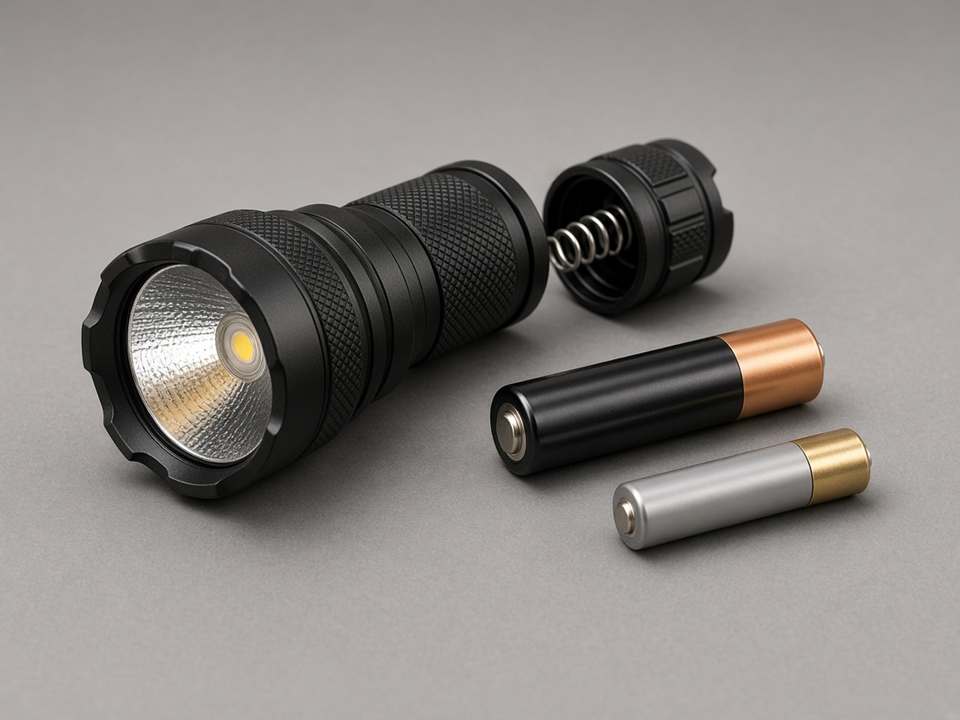
Alkaline cells are cheap and long-lasting on a shelf but sag and leak under high drain. NiMH AA cells give 1.2 V, recharge hundreds of times and hold charge when idle. A rechargeable 18650 lithium-ion cell stores two to three times as much energy and delivers high current, but needs a good charger.
| Cell | Nominal voltage | Typical capacity | Best for | Watch out for |
|---|---|---|---|---|
| Alkaline AA | 1.5 V | 2,000–3,000 mAh (low drain) | Emergency kits, low-power lights | Voltage sag at high drain, leaks when depleted |
| NiMH AA (low self-discharge) | 1.2 V | 1,900–2,800 mAh | Everyday lights, 500–2,000 recharges | Slightly lower voltage, so a little less peak output |
| Lithium primary AA / CR123A | 1.5 V / 3 V | ~3,000 / ~1,500 mAh | Cold weather and long storage (shelf life of 10 years or more) | Not rechargeable, higher price |
| Li-ion 18650 | 3.6–3.7 V (4.2 V full) | 2,500–3,600 mAh | High-output lights | Needs a proper charger, protection, quality cells |
| Li-ion 21700 | 3.6–3.7 V (4.2 V full) | 4,000–5,000 mAh | Larger lights, long runtime | Larger and heavier than 18650 |
An 18650 is 18 mm wide and 65 mm long. Use protected cells (with a built-in circuit against over-discharge and shorts) unless the light has its own protection, charge only with a charger made for lithium-ion, and never mix cells of different brands, charge levels or ages in one light. Counterfeit cells labeled with 6,000–9,900 mAh are fake: no genuine 18650 holds more than about 3,600 mAh. Li-ion cells should not be charged below 0 °C. Alkaline performs poorly in the cold, so use lithium primary cells for winter work. Carry spare lithium-ion cells in a case, in carry-on baggage.
What do the ANSI FL1 ratings on the box mean?
ANSI FL1 is a standard that defines how makers must measure and label a flashlight. It covers light output in lumens measured 30 seconds after switching on, runtime until output falls to 10%, peak beam intensity in candela, beam distance, drop resistance and water resistance rated IPX4, IPX7 or IPX8.
The standard (ANSI/PLATO FL 1) makes flashlight claims comparable, with a few quirks to know. Output is measured 30 seconds after turn-on, so a turbo mode that steps down after 90 seconds is credited at its 30-second figure. Runtime ends when output falls to 10% of that, a level so dim that it is barely useful, so a "30-hour" runtime may hide long hours at a dim glow; look for the time to 50% or the regulated period. Impact resistance is the drop height onto concrete, and water resistance follows the IP system: IPX4 splash, IPX7 immersion at 1 m for 30 minutes, IPX8 immersion at a depth stated by the maker (at least 2 m) for 4 hours. See the IP ratings table for other codes. FL1 is self-declared by the maker, with no independent certification, so third-party measurements in an integrating sphere are the best check.
How do you estimate a flashlight's runtime?
Multiply battery voltage by capacity in amp-hours to get watt-hours, take about 90% for driver losses, and divide by the LED's power draw. A 3,000 mAh 18650 holds about 10.8 Wh, so a mode drawing 3 W runs roughly three hours. Heat can force high modes to step down early.
For the 18650 example: 3.6 V × 3.0 Ah = 10.8 Wh, × 0.9 driver efficiency ≈ 9.7 Wh, ÷ 3 W ≈ 3.2 hours. At around 3 W an LED flashlight typically gives roughly 300–400 lumens, depending on the emitter and optics. The same cell at 10 W lasts under an hour, and turbo modes of 20 W or more drain a cell in minutes, and cannot be held, because the head heats up and the driver steps output down to protect the LED. The useful number for a high-output light is therefore the sustained output after step-down, not the turbo peak. A regulated driver holds brightness steady until the battery is nearly empty, whereas an unregulated light dims gradually as it drains.
Can a flashlight really make 100,000 lumens?
Rarely, and never from a pocket light. Light output cannot exceed power times efficacy, and a battery and a heat sink limit both. At 100–130 lumens per watt, one 18650 cell cannot honestly produce more than a few thousand lumens, so claims in the tens of thousands or millions are inflated.
The physics gives a quick check. An LED turns power into light at roughly 100–130 lm/W when overdriven, and a single 18650 cell can supply about 40–100 W briefly, which caps a one-cell light at roughly 4,000–10,000 emitter lumens before the lens takes its share. A genuine 100,000-lumen light needs on the order of 800 W, which means many cells, a large cooling mass and a runtime of minutes. Marketplace claims such as "9,000,000 lumens" are numbers with no meaning. Other tricks include quoting the sum of the rated lumens of the LEDs inside the light (emitter lumens) instead of the light that leaves the lens (out-the-front lumens), quoting a peak that lasts seconds, and listing a "CREE" emitter that is a copy. To protect yourself, look for a stated FL1 label, compare candela and beam distance, check the time to 50% output and prefer makers or reviewers who publish integrating-sphere measurements.
What should you look for in an LED headlamp?
Headlamps follow the same lumen, candela and FL1 rules, with extra points for comfort. Camp and chores need 100–300 lumens, trail running and night hiking 400–1,000, and anything higher is for specialist use. Look for a flood and spot mix, a red mode, IPX4 or better and a balanced battery.
Because a headlamp points wherever you look, a wide, soft flood is the main beam for close work, with a narrower spot for distance. Red mode protects night vision and does not blind companions at camp. Rear-mounted battery packs balance weight on a long run. Check the time at the level you will use, since many headlamps quote runtime at the lowest setting. A lock-out mode prevents the lamp switching on in a pack and draining the cell.
Frequently asked questions
How many lumens do I need in a flashlight?
For walking, camping and household use, 100–300 lumens is plenty. Hiking and trail running often use 300–1,000. Above 1,000 lumens the extra light helps mainly with search and rescue, caving or wide-area work, and it drains the battery fast.
Does a higher lumen number mean a flashlight throws farther?
No. Throw depends on candela, which reflects how tightly the light is focused. A 1,000-lumen thrower can reach several times farther than a 3,000-lumen flood light.
Can I use rechargeable NiMH batteries in any alkaline flashlight?
Usually yes: most lights made for 1.5 V alkaline cells also run on 1.2 V NiMH, and a regulated driver holds brightness steady on both. An unregulated light may be slightly dimmer on NiMH, so check the manual.
Is it safe to leave an 18650 light charging overnight?
With a light or charger that has end-of-charge cut-off and a protected cell from a reputable maker, it is normally safe, and a charger made for lithium-ion is safest. Do not charge on a bed or sofa, and stop using cells that are swollen, hot or damaged.
What does IPX8 mean on a flashlight?
Under FL1, IPX8 means the light survived immersion at a depth stated by the maker, at least 2 m, for 4 hours. IPX7 means 1 m for 30 minutes, and IPX4 means splashing only. See the IP ratings table.
Why does my flashlight get dimmer after a minute on high?
Thermal step-down. The LED and driver heat up quickly in a small body, so the driver reduces power to protect them. A larger body, a finned head and a metal build hold high output longer.
Are alkaline batteries dangerous in flashlights?
They can leak potassium hydroxide as they discharge fully or age, which corrodes the contacts. Remove them from lights that are stored for long periods, or use lithium primary cells, which are far less prone to leak.
Sources and further reading
- ANSI/PLATO FL 1-2009 (now ANSI/NEMA FL 1), Flashlight Basic Performance Standard: output, runtime, peak beam intensity, beam distance, impact and water resistance.
- IEC 60529, Degrees of protection provided by enclosures (IP Code) (IPX4, IPX7 and IPX8).
- IESNA, The Lighting Handbook: luminous intensity, the inverse-square law and photometric units.
- Battery University (Cadex), BU-205 to BU-216, on lithium-ion, nickel-metal hydride and alkaline cells, cold-temperature behavior and charging.
- U.S. FAA PackSafe guidance on spare lithium batteries in carry-on baggage.
- Lumileds Luxeon and Cree XLamp datasheets: emitter efficacy and lumens versus drive current.
Image credits
- Flood vs throw beam comparison and 18650 vs AAA battery comparison: AI-generated illustrations for LEDlights.org.