LED shop lights and high-bays
Garage strips, UFO and linear high-bays, mounting heights, lux targets, T8 tubes and ballast bypass safety
A high-bay light is a high-output fixture, usually 100–240 W and 15,000–36,000 lumens, hung from ceilings about 15–40 feet up in warehouses, factories and gyms. A shop light is a lower-output strip, usually 4 or 8 feet long, for garages, basements and workbenches under ceilings of roughly 8–14 feet.
Garages, workshops and warehouses all want the same thing: bright, even, glare-free light that switches on instantly in the cold. What changes is the ceiling height and the amount of light required. This guide covers 4 ft and 8 ft shop strips, UFO versus linear high-bays, mounting heights and lux targets, Type A, B and C LED tubes and the safety rules for bypassing a ballast, then efficacy, glare, color temperature and DLC listing. For the overview and the energy savings math, see high-bays and warehouses and offices, schools and retail.
What LED shop light do you need for a garage: 4 ft or 8 ft?
A 4 ft LED shop light gives 4,000–5,500 lumens from 35–50 W, and an 8 ft strip gives 8,000–10,000 lumens from 72–100 W. Pick 4 ft units for easy hanging and linking, 8 ft for long, straight runs with fewer fixtures and fewer power drops. Both suit ceilings of 8–12 feet.
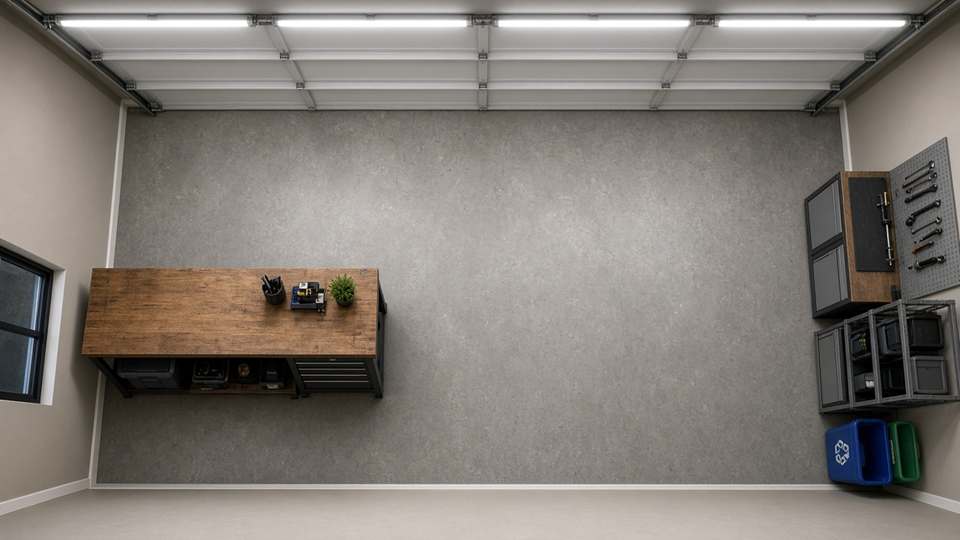
Both sizes are linkable, meaning one plug powers a daisy chain of fixtures up to a stated maximum, typically 1,000 to 1,800 W of total load on a plug-in set. Four-foot units are light enough for chains and a single person to hang, and they fit between joists. Eight-foot units cost less per lumen and need fewer mounting points, but they are awkward to carry, and some fixtures are too long for a one-car garage door track.
For layout, use the lumen method from the lux guide: lumens ≈ floor area × target foot-candles ÷ 0.6. A 20 × 20 ft two-car garage at 300 lux (about 28 foot-candles) needs roughly 400 × 28 ÷ 0.6 ≈ 18,700 lumens, which is four 5,000-lumen 4 ft strips. Hang two rows, one over each side of the parked vehicles rather than over the roof, so the light falls on doors, hoods and the bench, not on the top of the car.
| Fixture | Typical output | Typical power | Best for |
|---|---|---|---|
| 4 ft strip | 4,000–5,500 lm | 35–50 W | Garages, basements, benches, tight joist spacing |
| 8 ft strip | 8,000–10,000 lm | 72–100 W | Larger shops, long straight runs, fewer fixtures |
| 4 ft linear high-bay | 14,000–22,000 lm | 100–150 W | Ceilings of 12–20 ft, racking aisles |
Garages that are not heated and conditioned need fixtures marked for damp locations at least, and dusty or hosed-down spaces need IP65. Cold is not a problem, because LEDs start instantly and run efficiently at low temperature; check the lowest operating temperature on the label, often −20 °C or −40 °C. For driveways and yards, use the outdoor lighting guide instead.
UFO vs. linear high-bay: which shape is better?
UFO high-bays are round, finned fixtures with a tight, bright beam that suit open floors, high ceilings and hot, dusty places. Linear high-bays are long, flat fixtures with wider, softer light that suit aisles, racking and lower ceilings. Linear fixtures usually glare less; UFOs usually mount higher and cost less.
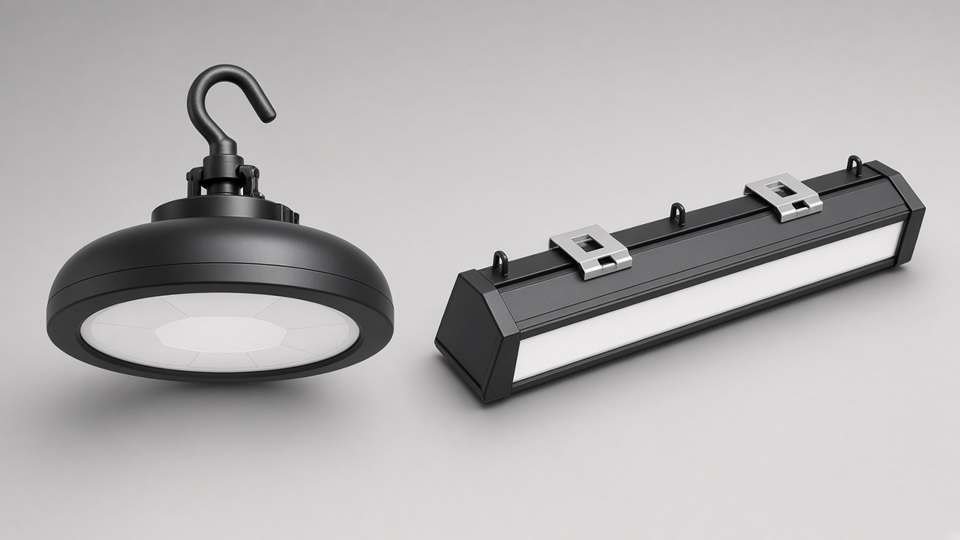
A UFO high-bay packs LEDs on a round board behind a lens or reflector and cools through a ribbed aluminum body. That heat sink handles hot ceilings, and the sealed round shape is simple to hang from a hook or pendant. Optics are usually 60°, 90° or 120°: narrow for 30 ft and above, wide for 15–25 ft.
A linear high-bay spreads the same lumens over a 2 ft or 4 ft frosted or prismatic lens, so the surface is larger and each point is less bright. That lowers glare when workers look up, and the rectangular pattern lights both sides of a rack aisle evenly, including the vertical faces where labels are read. Linear units are thinner and easier to chain, and many have a daylight or motion sensor port.
| Feature | UFO high-bay | Linear high-bay |
|---|---|---|
| Output | 15,000–36,000 lm (100–240 W) | 10,000–30,000 lm (80–220 W) |
| Distribution | Round, 60–120° optics | Wide rectangular, soft edges |
| Glare | Higher, small bright source | Lower, larger lens |
| Best ceiling | 20–40 ft | 12–25 ft |
| Best use | Open floors, gyms, hot or dusty plants | Racking aisles, retail, shops, light assembly |
How do mounting height and lux targets set the fixture size?
Taller ceilings need more lumens per fixture and tighter beams, because light spreads and weakens with distance. As a guide, 15–20 ft needs about 15,000 lumens, 20–30 ft about 20,000–30,000, and 30–40 ft about 30,000–36,000 with a narrower optic. Space fixtures about one to 1.5 times the mounting height.
Mounting height, beam cones and work plane
Light intensity falls with the square of distance, so a fixture twice as high lights a given spot with a quarter of the light unless the beam is narrowed. Mounting height is measured to the fixture, but the target is the work plane, usually the floor or a bench about 3 ft up. Subtract that from the ceiling height when you choose.
| Mounting height | Typical lumens per fixture | Common optic | Spacing |
|---|---|---|---|
| 12–15 ft | 10,000–15,000 lm | Linear or 120° UFO | 10–20 ft |
| 15–20 ft | 15,000–22,000 lm | 90–120° UFO or linear | 15–25 ft |
| 20–30 ft | 20,000–30,000 lm | 90° UFO | 20–35 ft |
| 30–40 ft | 30,000–36,000 lm | 60° UFO | 30–45 ft |
What lux targets suit a garage, shop or warehouse?
Typical maintained targets are 100–300 lux for garages and warehouse aisles, 200–300 lux for active picking and packing, 300–500 lux for general assembly and workshops, and 500–1,000 lux for fine bench work. One foot-candle is about 10.76 lux. Design 25–40% higher at installation to allow for dirt and lumen loss.
These ranges follow the IES recommended practice for industrial lighting and match the table in the applications guide. Worked example: a 100 × 100 ft warehouse (929 m²) at 200 lux needs about 929 × 200 ÷ 0.6 ≈ 310,000 lumens, which is about fourteen 22,500-lumen (150 W) high-bays. At that count, each covers about 714 sq ft, a spacing near 27 ft, which fits a 25 ft mounting height. Try your own fixture counts in the energy calculator.
Which Type A, B or C LED T8 tube fits an old shop light?
Type A tubes run on the existing fluorescent ballast and are the simplest swap. Type B tubes need the ballast removed and mains wired to the sockets. Type C tubes run from a separate low-voltage driver. Choose Type A for speed, Type B for lowest long-term cost, and Type C for dimming and the best efficiency.
Type A, B and C LED T8 wiring
The old T8 fixture has a ballast that limits current to the fluorescent lamp. A Type A LED tube works with a compatible ballast, so the tube swap takes minutes, but the ballast still wastes a few watts and will eventually fail. Type B tubes contain their own driver and take line voltage directly. Type C tubes are powered at low voltage by a remote LED driver, which can be dimmable and often lasts longest. Hybrid Type A/B tubes work either way. The table in the bulb shapes guide compares them in more detail.
| Type | Power source | Rewiring | Trade-off |
|---|---|---|---|
| A (plug and play) | Existing electronic ballast | None | Ballast loss and failure risk remain |
| B (ballast bypass) | Mains to the sockets | Yes, remove the ballast | Lowest running cost; needs correct wiring and a label |
| C (remote driver) | External LED driver | Yes, new driver and wiring | Best dimming; highest installed cost |
| A/B (hybrid) | Ballast or mains | Optional | Flexible; check which mode the maker lists |
In North America, Type A tubes are certified under UL 1993, and Type B and C retrofits under UL 1598C. A Type A tube listed for electronic ballasts will not always work on an older magnetic ballast, so check the compatibility list on the maker's site before buying a case. Remember that the fixture should be cleaned and its sockets inspected when you retrofit, because cracked sockets are a common cause of flicker.
How do you bypass a ballast safely, and what is single- vs. double-ended?
Turn off the breaker, lock it out, and confirm the circuit is dead with a tester before touching wires. Single-ended tubes take line and neutral at one socket end; double-ended tubes take line at one end and neutral at the other. Wire to the tube's diagram, use non-shunted sockets, and label the fixture.
Single-ended vs double-ended Type B
- Lock out the circuit. Switch off the breaker, apply a lock and tag so nobody restores power, and test the fixture wires with a voltage tester. This is the standard lockout/tagout practice for any workplace.
- Check the tube's diagram. A single-ended tube is powered through the pins at one end only; the other end is a dummy. A double-ended tube takes line at one end and neutral at the other and is energized only when both ends are seated. They are not interchangeable.
- Remove the ballast and wire the sockets exactly as the maker shows. Replace shunted (tombstone) sockets with the non-shunted type, because a shunt across line and neutral is a short circuit. Do not mix Type A and Type B tubes in one fixture.
- Label and test. Add the "fixture modified, line voltage at lamp sockets" warning and insert tubes only with power off. A single-ended tube is live at its powered end the moment it is energized, and a double-ended tube can expose live pins at one end while the other is half-seated.
If you are not comfortable with fixture wiring, hire a licensed electrician. Rules vary by jurisdiction, and some commercial buildings require a permit for a conversion. Where a conversion is not wanted, a plug-in Type A tube or a complete new LED fixture avoids the issue.
How do efficacy and glare change which fixture you buy?
Compare delivered lumens per system watt: good shop strips reach 100–130 lm/W, and good high-bays 140–180 lm/W. Higher efficacy cuts power but does not fix glare. Control glare with diffusing or prismatic lenses, mounting higher, and shielding. EN 12464-1 limits unified glare rating to 25 for rough work and 22 for general work.
Efficacy is lumens divided by input watts, measured for the whole fixture, driver included. Choose by lumens per watt at the stated CCT and by lumens delivered to the floor, not by the chip count or a "400 W equivalent" claim. A high lm/W figure on a bare-chip fixture can still be unpleasant: a small, extremely bright source seen from a bench is what causes discomfort glare, so a frosted lens or louvre is worth a few percent of efficacy.
For work under moving machinery, pick low-flicker drivers. Cheap drivers can create a stroboscopic effect that makes a spinning blade look stationary. The flicker guide explains the numbers. Dimming and occupancy sensors typically save another 20–40% in aisles that are empty most of the day.
What color temperature is best for a workshop?
Use 4000–5000 K for workshops and garages. Around 4000 K looks neutral and comfortable for general work, while 5000 K is crisp, daylight-like and helps with fine detail and inspection. Choose CRI 80 or higher for general shops, and CRI 90 or higher for paint, finishing and wood color matching.
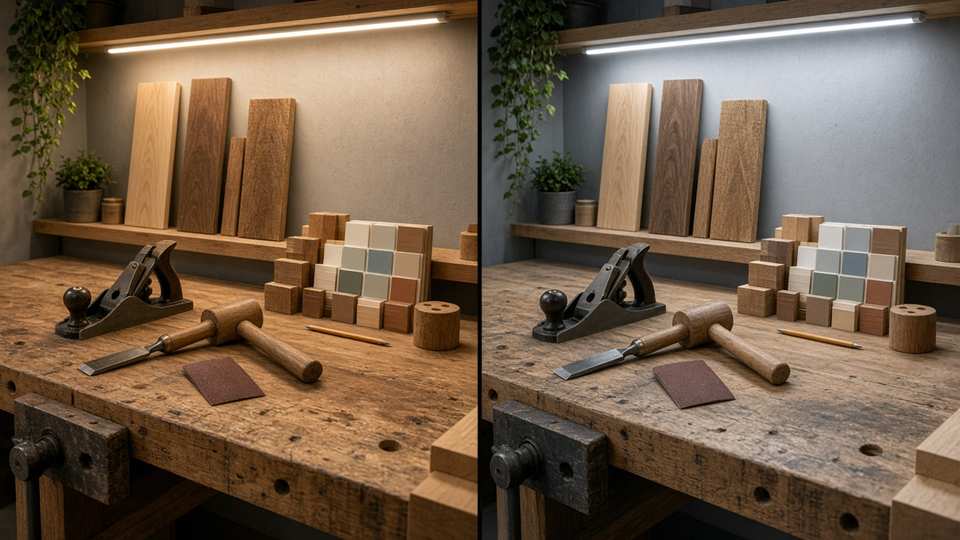
Color temperature (CCT) describes how warm or cool the white looks, and CRI describes how faithfully colors appear. The CCT and CRI guide explains both. Warmer 3000 K can suit an attached garage that doubles as a living space, while 6500 K is bluer than most people like indoors and can feel harsh. Use one CCT across a room so surfaces do not shift color between fixtures, and put the same CCT on your task light as on the ceiling lights.
What does DLC listing mean for high-bays and shop lights?
DLC means the DesignLights Consortium has verified a commercial fixture's efficacy, light distribution and lumen maintenance, and put it on its Qualified Products List. Most utility rebates require a DLC-listed fixture. DLC Premium sets higher efficacy and longer warranty requirements. UL or ETL marks cover safety, which is separate.
Check the listing on the DLC database by manufacturer and model number, not by a logo on a box. A fixture can have a UL or ETL mark for electrical safety and still be absent from the DLC list, and the reverse is also possible for older products. Also check that the exact wattage and CCT variant you will buy is listed, because variants are qualified individually.
When should you use a high-bay instead of a shop strip?
Use shop strips and wraps under ceilings of about 8–12 feet. From 12 to 15 feet, a linear high-bay or low-bay fixture is the middle ground. Above about 15 feet, use UFO or linear high-bays, because strips cannot deliver enough light at that distance without close spacing, glare or too many fixtures.
Shop strip vs high-bay by ceiling height
| Ceiling height | Best fixture | Typical space |
|---|---|---|
| 8–12 ft | 4 ft or 8 ft shop strip, T8 LED tubes | Garage, basement, small shop |
| 12–15 ft | Linear high-bay, low-bay, or wide-beam UFO | Large garage, retail back room, small plant |
| 15–25 ft | Linear high-bay or 90–120° UFO | Warehouse aisles, gym, workshop |
| 25–40 ft | UFO high-bay, 60–90° optic | Distribution center, hangar, factory floor |
Retrofitting existing T8 or T5HO fixtures is a different choice: keep the fixture and swap the lamps if the housing is sound and the ceiling is low, but replace the whole fixture where the ballast, sockets or reflectors are old, or where you need better optics. Whole-fixture replacement removes the ballast problem entirely and usually earns a larger rebate. The energy calculator gives the payback for each option.
Frequently asked questions
How many lumens do I need for a two-car garage?
About 15,000–20,000 lumens gives a bright general level of 250–300 lux in a 20 × 20 ft garage, which is four 4 ft shop lights. Add a task light at the workbench for the 500 lux needed for detailed work.
Can I use LED high-bays in a garage?
Yes, if the ceiling is at least about 14–15 feet. Under a standard 8–10 ft ceiling a high-bay is too bright and glary at close range, so shop strips are the better, cheaper choice.
Do I have to remove the ballast for an LED tube?
Only for Type B tubes. Type A tubes work with a compatible ballast, Type C tubes use their own external driver, and hybrid Type A/B tubes work either way. Always read the tube's wiring diagram first.
Is it safe to use a single-ended tube in a double-ended fixture?
No. The wiring is different and a mismatch can energize both pins at the wrong end or short the circuit. Rewire the sockets for the tube you bought, use non-shunted sockets, and label the fixture.
Is a UFO or a linear high-bay better for racking?
A linear high-bay is usually better. Its wide, even distribution lights both sides of an aisle and the vertical rack faces with less glare than a round UFO with a narrow beam.
What color temperature is best for a garage?
Around 4000–5000 K. Choose 4000 K for a comfortable, neutral look, and 5000 K when you do fine work, inspection or paint matching. CRI 80 or higher is enough, and 90 or higher is better for color-critical jobs.
Are cheap non-DLC high-bays worth it?
For a home garage, many are fine if they carry a UL or ETL safety mark and honest lumen figures. For a business that wants a utility rebate, buy DLC-listed models, because the rebate often exceeds the price difference.
Will LED shop lights work in a cold garage?
Yes. LEDs start instantly and are slightly more efficient in the cold. Check the lowest operating temperature on the label, and use damp-rated or better fixtures if the garage is unheated and damp.
Sources and further reading
- Illuminating Engineering Society (IES), The Lighting Handbook, 10th edition, and IES RP-7, Recommended Practice for Lighting Industrial Facilities: maintained illuminance and uniformity for industrial spaces.
- UL 1993, Self-Ballasted Lamps and Lamp Adapters, and UL 1598C, Light-Emitting Diode (LED) Retrofit Luminaire Conversion Kits: certification for LED tubes and conversions.
- UL 1598, Luminaires: dry, damp and wet location listings for fixtures.
- U.S. Department of Energy, Solid-State Lighting program: LED luminaire efficacy and lifetime reports, and LED Lighting Facts guidance for high-bay and linear fixtures.
- DesignLights Consortium (DLC), Qualified Products List and technical requirements for Linear Ambient, Industrial and High-Bay categories.
- EN 12464-1:2021, Light and lighting: Lighting of work places, Part 1: Indoor work places: UGR limits and recommended illuminance.
- OSHA 29 CFR 1910.147, The control of hazardous energy (lockout/tagout).
Image credits
- Garage and UFO overview, 4 ft vs 8 ft layout, UFO vs linear comparison, and 4000 K vs 5000 K workshop: AI-generated illustrations for LEDlights.org.
- Mounting-height, T8 Type A/B/C, single- vs double-ended wiring, and high-bay vs shop-strip diagrams: drawn by LEDlights.org.