LED Christmas lights
LED vs incandescent, C7, C9 and mini strings, warm white, outdoor ratings, failures and safety
LED Christmas lights are seasonal light strings that use light-emitting diodes instead of tiny incandescent filament bulbs. They sit on a standard plug and cord, are tested under UL 588 in North America, and use a fraction of the power, give off little heat and last for many seasons.
Swapping to LED Christmas lights cuts the electricity bill and the heat on the tree, but the boxes in the store do not make the choice easy. Mini, C7, C9, warm white, full-wave, indoor, outdoor: each label means something specific. This guide explains the real differences between LED and incandescent sets, how the strings are wired, why half of a string goes dark, and what to look for on the label.
Are LED Christmas lights better than incandescent ones?
Mostly yes. LED strings use roughly 85–90% less power, stay cool to the touch, and are rated for 20,000 hours or more against 1,000–3,000 for incandescent. Incandescent sets win only on the exact amber glow of a heated filament, and on price for the cheapest sets.
Energy is the largest gap. A 100-bulb incandescent mini set is typically 40 W, and an LED set of the same length typically 4–6 W. Take 1,000 mini lights lit six hours a night for 40 nights, with 5 W per 100 LEDs: that is about 96 kWh for incandescent and 12 kWh for LED, or roughly $16 against $2 at 17 cents per kWh. The energy-savings calculator runs the same arithmetic for your own rate and hours.
| Feature | Incandescent | LED |
|---|---|---|
| 100 mini lights | About 40 W | About 4–6 W |
| 25 C9 bulbs | About 175 W (7 W each) | Well under 25 W |
| Heat | Bulbs get hot, C7 and C9 especially | Barely warm |
| Rated life | Commonly 1,000–3,000 h | Commonly 20,000 h or more |
| Usual failure | Burnt filament, loose bulb | Driver, wire, socket or moisture |
| Glow | Soft, warm, slightly uneven | Bright point sources, vivid colors |
| Sets per outlet | A few; read the label | Many more; read the label |
Heat is the safety difference. Incandescent bulbs turn most of their power into heat, and a 7 W C9 bulb can scorch dry needles or burn a finger. LED bulbs stay barely warm, which matters on a dry tree, a wreath or a gutter. Longevity follows the same pattern: LEDs have no filament to burn out, and 20,000 hours is more than 80 seasons at 240 hours each. In practice the cord, plug and sockets wear out first, so a warranty and a UL mark are better guides to life than the hours on the box.
Look is the one place incandescent still has fans. A heated filament glows soft and a little uneven, and a dimmed one turns warmer; most LED strings do not shift color. Better LED sets now come close, as the next section explains.
What are C7, C9 and mini Christmas lights?
C7 and C9 are the large bulbs, named by width in eighths of an inch: a C7 is 7/8 inch across on an E12 candelabra base, and a C9 is 1⅛ inch on an E17 intermediate base. Mini lights are the small bulbs on thin wire. Icicle, net and curtain sets are minis arranged in shapes.
| Type | Size and base | Typical use |
|---|---|---|
| Mini | Small bulb or 5 mm LED, in a push-in socket | Trees, wreaths, garland, shrubs |
| C7 | 7/8 inch bulb, E12 base, up to 5 W incandescent | Rooflines, smaller trees |
| C9 | 1⅛ inch bulb, E17 base, up to 7 W incandescent | Rooflines, large trees, eaves |
| Globe | Round bulbs on candelabra or mini sockets | Patios, porches, wide trees |
| Icicle, net, curtain | Minis on pre-arranged wire | Eaves, shrubs, windows |
| Rope, fairy | LEDs in a tube or on thin copper wire | Railings, mantels, jars |
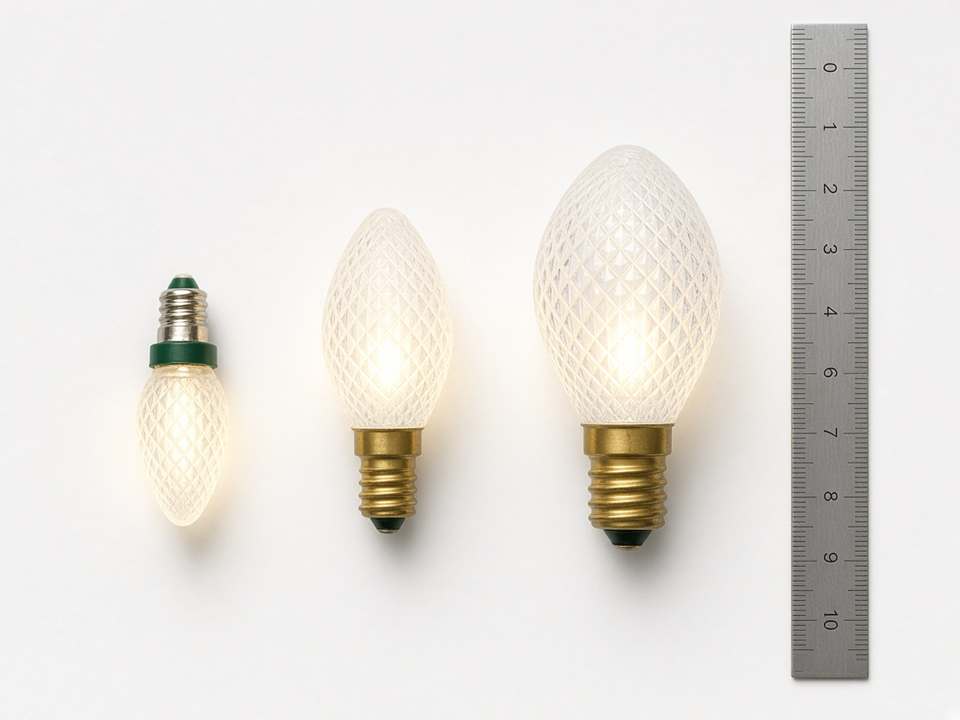
Most LED minis are 5 mm LEDs in a conical or faceted lens, the same through-hole package described in through-hole (DIP) LEDs. LED C7 and C9 bulbs put the LED and a small circuit inside a bulb-shaped shell, often with a faceted or smooth plastic lens. The base size is what matters if you swap bulbs: the dimensions of E12 and the larger E17 are covered in the small Edison screw guide.
Which LED Christmas lights look like old incandescent ones?
Look for a stated color temperature of 2200–2700 K, often sold as warm white, extra warm or candlelight. Incandescent Christmas bulbs glow at roughly 2400–2700 K. Anything sold as cool white, or 5000 K and up, looks blue-white beside them. Colored LEDs are more saturated than the coated glass of old bulbs.
"Warm white" is not a standard term, so the same words cover very different lights. Some cheap sets look yellow-green or slightly pink, and others lean blue. Check the box for a kelvin figure, and if you have a lit incandescent string on hand, compare one bulb from the new set against it before buying a whole display. Color temperature explains what the numbers mean.
White LEDs make light by coating a blue LED with phosphor, so the warm versions simply use more of the red-yellow phosphor. Color rendering matters little for decorations that nobody uses to read or cook by. The color of the glow is what counts, and the kelvin number tells you that.
What rating do outdoor Christmas lights need?
Use only sets marked for outdoor use. In North America that means a UL, ETL or CSA listing to UL 588 with the red UL label, and in Europe an IP44 or higher rating. Indoor-only sets, with the green label, are not built for rain. Keep plugs off the ground and use a GFCI outlet.
| Marking | Meaning |
|---|---|
| Red UL label | Set is listed for indoor and outdoor use |
| Green UL label | Set is listed for indoor use only |
| ETL or CSA mark | Tested to the same standard by another recognized lab |
| IP44 | Splash-proof; usual minimum for outdoor sets in Europe |
| IP65 | Protected against water jets; commercial or low-voltage sets |
| "W" on a cord | Extension cord suitable for outdoor use |
The weak point is not the bulbs but the joints. Water collects where one plug meets the next socket or an extension cord, so raise connections off the ground and snow, and use a weatherproof cover or a sealed plug housing. Choose extension cords marked "W". The US National Electrical Code requires GFCI protection on outdoor receptacles at dwellings, which cuts off the current if a leak does reach the wiring. For how wet and damp ratings work on fixtures, see the outdoor lighting ratings guide.
One difference from incandescent sets: a cold LED will not melt snow, so a string buried in a drift stays buried. Clear it by hand before it adds weight to a gutter or branch.
How are Christmas light strings wired: series, parallel or full-wave?
Mini incandescent sets wire bulbs in series, so each shares the line voltage and a burnt-out bulb needs a shunt to keep the rest lit. C7 and C9 sets wire full-voltage bulbs in parallel. LED sets run many LEDs in series from rectified current, and full-wave rectified sets flicker less than half-wave ones.
In a 50-bulb series section on 120 V, each mini bulb gets about 2.4 V. Remove one and the loop opens, so the whole section goes dark. To prevent that, a mini bulb has a shunt at its base: when the filament fails, the shunt closes and carries the current. The remaining bulbs then share a little more voltage each, which makes them age faster, so replace a dead bulb promptly.
A C7 or C9 bulb is built for the full 120 V and wired in parallel with the rest. One bulb out leaves the others unaffected. LED sets cannot run on 120 V directly, because an LED needs only 2–3 V and passes current in one direction. The set uses a rectifier and a current-limiting resistor or driver, with LEDs in series, and C7 and C9 LED bulbs put that electronics inside each bulb.
What does "full-wave rectified" mean on LED light sets?
An LED conducts in one direction only, and household current reverses 60 times a second. A half-wave set lights its LEDs for half of every cycle, so they pulse at 60 Hz, which some people see as flicker and cameras record as banding. A full-wave rectified set uses the whole cycle and pulses at 120 Hz.
A full-wave set uses a bridge of four diodes to turn both halves of the alternating current into pulses the LEDs can use. The pulses come twice as often, so flicker is much harder to notice. On 50 Hz supplies the figures are 50 and 100 Hz. Light output also looks steadier to the eye. If you film your display or are sensitive to flicker, choose full-wave sets; the box often says so.
Why did half of my Christmas light string go out?
Most 100-light sets are two 50-light series sections wired side by side. When a bulb or socket in one section opens the circuit, that half goes dark while the other half stays lit. Check for a loose, missing or broken bulb first, then the plug fuse, then a damaged socket or cut wire in the dark half.
- Unplug the set. Press each bulb in the dark half firmly into its socket, as one loose bulb opens the whole section.
- Look for a missing bulb, a cracked base or a bent contact. Replace a bad bulb with one of the same voltage and wattage.
- If the whole set is out, open the sliding cover on the plug and check the two small fuses. Replace them only with the exact rating printed on the plug or label.
- If a new fuse blows at once, stop using the set. That points to a short, not a bad bulb.
Many LED sets have bulbs that cannot be replaced, so a dead section often means a failed LED, a broken wire or a corroded socket. Check for water in the sockets first, especially if the set was outdoors. If a repair needs cutting wire, replace the set instead: a taped splice outdoors is exactly where water gets in.
How do blinking, twinkling and color-changing controllers work?
Old incandescent sets blink with a thermal flasher bulb: a bimetal strip heats, bends and breaks the circuit, then cools and closes it again. LED sets use a small electronic controller in the plug or on the cord to fade, chase or twinkle the string. Check the controller's rating before adding sets.
Controllers are rated in watts or amps, and an LED string draws so little that the limit is rarely reached, but a controller made for one type of set should not be used with another. Do not plug LED strings into a wall dimmer unless the box says dimmable, because many dimmers cause flicker or buzzing on LED loads. For daily on and off, a plug-in timer or smart plug is the simpler choice, and it saves the hours you would otherwise forget.
Color-changing sets with individually addressable pixels work differently. They run from a low-voltage DC power supply and a controller, much like an RGB strip. Size the supply to the total load listed on the product.
What makes Christmas lights safe to use?
Buy sets listed by UL, ETL or CSA, a mark showing they were tested to UL 588. Use them only where the label allows, do not exceed the stated number of connected strings, replace fuses with the same rating, and discard sets with cracked sockets or damaged wire. Switch them off when you leave or sleep.
UL 588 is the safety standard for seasonal and holiday decorative products, covering cord, plugs, sockets, wattage limits and labeling. A listing mark means the product was tested to it, not that it is safe under every use. The label's connection limit is the number that matters most: it is set by the cord's current rating and the plug fuse, so exceeding it overheats the first cord in the run.
Other basics apply. Never use electric lights on a metal tree, as a fault can energize the whole tree. Keep a cut tree watered, and keep lights from sitting on dried needles. Do not run cords under rugs or through doors and windows that pinch them. Plug strings into an outlet circuit that is not already heavily loaded: a 15 A circuit carries 1,800 W, or 1,440 W at the 80% level used for loads that stay on for hours.
Frequently asked questions
Can I connect LED and incandescent sets end to end?
Not unless the label says so. The maximum number of connected sets is stated per type of set, and a mixed run breaks those figures. Use a separate outlet or extension cord for each type instead.
Why do my LED Christmas lights flicker on camera?
Probably a half-wave rectified set, which pulses at 60 Hz. A camera's shutter catches the dark half of each cycle and shows banding. A full-wave rectified set pulses at 120 Hz and flickers far less; see full-wave rectified.
Can I replace incandescent C9 bulbs with LED ones?
Usually, yes, if the set is wired in parallel at line voltage and the socket is E17. Match the base, replace the bulbs in the whole set so the color matches, and check the voltage and wattage on the bulb. See the small Edison base guide.
Do LED Christmas lights get hot?
The LED bulbs stay barely warm, though the plug, rectifier or controller box can feel slightly warm. Hot spots, melted plastic or a burning smell mean the set is faulty, and you should unplug it.
How many strings can I connect together?
Follow the label first: it states the maximum for that set. Beyond that, the outlet circuit limits you. A 15 A circuit carries 1,800 W, or 1,440 W if you keep to 80% for lights that stay on for hours, and other devices may share it.
Are LED Christmas lights worth the extra cost?
For a large display, yes. At 17 cents per kWh, 1,000 mini lights save about $14 a season, and LEDs also run cooler and last longer. For one small tree the saving is a few dollars, so the longer life and lower heat decide it. Use the energy calculator for your numbers.
Can I use indoor Christmas lights outside?
No. An indoor-only set, marked with the green UL label, is not built for rain, snow or sprinklers. Use a set with the red label or an IP44 or higher rating, and see the outdoor ratings guide.
Sources and further reading
- UL 588, Seasonal and Holiday Decorative Products; Underwriters Laboratories guidance on holiday lighting and its green (indoor) and red (indoor and outdoor) holographic labels.
- NFPA 70, National Electrical Code: Section 210.8 (GFCI protection) and Article 400 (flexible cords and the "W" outdoor marking).
- IEC 60529, Degrees of protection provided by enclosures (IP Code); IEC 60598-2-20 (EN 60598-2-20), Luminaires: Particular requirements, Lighting chains.
- U.S. Department of Energy, Energy Saver, "Holiday Lighting"; ENERGY STAR, decorative light strings program requirements (energy and lifetime comparisons).
- U.S. Consumer Product Safety Commission, holiday decoration safety tips (metal trees, connection limits, damaged cords).
- ANSI C79.1, Nomenclature for Glass Bulbs Intended for Use with Electric Lamps (C-shape bulb sizes in eighths of an inch).
- U.S. Energy Information Administration, Electric Power Monthly: average residential electricity price, about 17 cents per kWh, used for the cost examples.
Image credits
- Roofline C9 and mini strings, and C7 / C9 / mini size comparison: AI-generated illustrations for LEDlights.org.