LED strip power supply and voltage drop calculator
How big a power supply you need, how much voltage the strip loses, and where to feed it
Voltage drop is the voltage lost in the copper of an LED strip and in the wires that feed it, because every conductor has some resistance. It grows with current and distance, so the far end of a long low-voltage strip receives less than the supply voltage and glows dimmer or changes color.
An LED strip needs two things from its power supply: enough watts, and enough voltage at every LED. The first is simple arithmetic. The second depends on how far the current has to travel through the strip's thin copper rails, which is why a 5 m reel can look bright at one end and dull at the other. This calculator checks both and shows where to feed power in.
LED strip calculator
Enter the strip voltage, its power per metre and the run length. The calculator gives the total watts and amps, the smallest power supply to run at 80% load or less, the lowest voltage anywhere on the strip, how long a run each feed point can serve, and the wire size that keeps losses small.
LED strip power and voltage drop
Pick a strip type, or enter the voltage and watts per metre from the strip's label or datasheet.
The resistance is for both copper rails together, per metre of strip. If the maker states a maximum run length, stay within it: the rails also have a current limit.
Markers show where power is fed in. The LED brightness is an illustration of the voltage along the strip, not a photometric prediction.
The calculator treats the strip as an even load spread along two copper rails, with each feed point serving the strip on either side of it. It assumes every LED draws its rated current whatever the voltage. That matches strips with a constant-current chip in each group and slightly overstates the drop on strips with resistors, whose current falls with the voltage, so the results err on the safe side.
Sizing the power supply
Multiply the strip's power per metre by its length, then divide by 0.8 so the supply runs at no more than 80% of its rating. Five metres of 14.4 W/m strip draws 72 W, so it needs a supply of at least 90 W, in practice 100 W, at the strip's own voltage.
The power on a strip's label is its full-brightness draw per metre. Dimming lowers it, but size the supply for full output anyway. Running a supply at 80% load or less keeps it cooler, and a cooler supply lasts longer because its electrolytic capacitors age faster with heat. Current is watts divided by volts, so the same 72 W draws 6 A at 12 V but only 3 A at 24 V. On RGB and addressable strips, the label figure means every color at full brightness: animations rarely reach it, but an all-white scene will.
Use a constant-voltage supply with the strip's voltage, never a constant-current LED driver (see constant current vs constant voltage). One larger supply with a separate feed to each run is fine for several runs; very large installations are easier to build and fault-find as zones with their own supplies.
| Strip | Voltage | Power per metre | Current per metre | 5 m draws | Minimum supply for 5 m |
|---|---|---|---|---|---|
| 3528, 60 LEDs/m | 12 V | 4.8 W | 0.4 A | 24 W, 2 A | 30 W |
| 2835, 120 LEDs/m | 24 V | 12 W | 0.5 A | 60 W, 2.5 A | 75 W |
| 5050, 60 LEDs/m | 12 V | 14.4 W | 1.2 A | 72 W, 6 A | 90 W |
| 5050, 60 LEDs/m | 24 V | 14.4 W | 0.6 A | 72 W, 3 A | 90 W |
| COB (dotless) | 24 V | 10 W | 0.42 A | 50 W, 2.1 A | 63 W |
| WS2812B, 60 LEDs/m | 5 V | 18 W | 3.6 A | 90 W, 18 A | 113 W |
| WS2812B, 144 LEDs/m | 5 V | 43 W | 8.6 A | 216 W, 43 A | 270 W |
Why the far end of a strip is dimmer
Current flows along two thin copper rails, and copper has resistance, so the voltage falls along the strip. Fed from one end, the drop at the far end is the total current × the rails' resistance per metre × the length ÷ 2. Because the current also grows with length, doubling a run quadruples the drop.

5 m of 14.4 W/m at 12 V: I = 72 W ÷ 12 V = 6 A → ΔV = 6 × 0.10 × 5 ÷ 2 = 1.5 V (12.5%)I is the strip's total current, r the resistance of both rails per metre (about 0.10 Ω on a typical strip) and L the length. Feeding both ends, or the middle, cuts the strip's drop to a quarter.
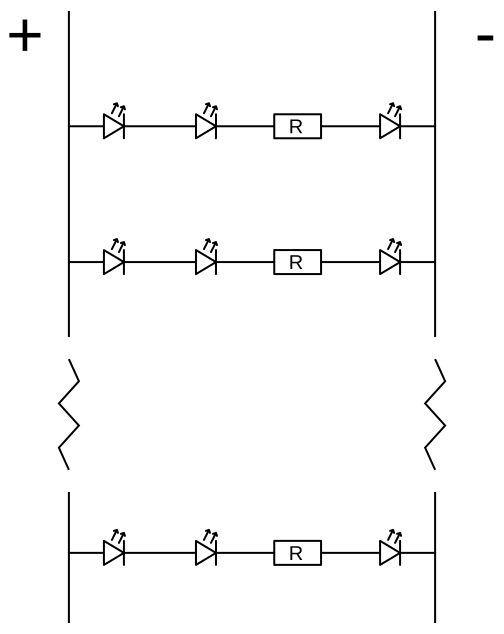
Inside the strip, the LEDs sit in short groups wired in parallel between the two rails. The first group gets the full supply voltage; each group further along gets a little less. On strips with a resistor in each group, current falls faster than voltage: a 12 V group of three white LEDs has only about 3 V to spare above their forward voltage, so losing 1 V cuts its current by about a third. Strips with a small constant-current chip in each group hold their brightness until the spare voltage runs out. On 5 V addressable strips the blue and green LEDs fade first, so white turns yellowish and then orange toward the end.
| Strip | Under 5% drop | Under 10% drop |
|---|---|---|
| 5 V, 18 W/m (WS2812B, 60/m) | 1.2 m (3.9 ft) | 1.7 m (5.5 ft) |
| 12 V, 4.8 W/m | 5.5 m (18 ft) | 7.7 m (25 ft) |
| 12 V, 9.6 W/m | 3.9 m (13 ft) | 5.5 m (18 ft) |
| 12 V, 14.4 W/m | 3.2 m (10 ft) | 4.5 m (15 ft) |
| 24 V, 9.6 W/m | 7.7 m (25 ft) | 11 m (36 ft) |
| 24 V, 14.4 W/m | 6.3 m (21 ft) | 8.9 m (29 ft) |
| 24 V, 19.2 W/m | 5.5 m (18 ft) | 7.7 m (25 ft) |
| 48 V, 14.4 W/m | 12.6 m (41 ft) | 17.9 m (59 ft) |
Power injection: feeding long runs
Power injection means running extra wires from the supply to more points along the strip, so no stretch of copper carries current far. Feeding both ends cuts the drop to a quarter. For longer runs, add feed points every few metres, each with its own wire pair from the supply, and fuse each feed.
- Both ends. Run a second pair of wires to the far end and connect positive to positive and negative to negative. The weakest point moves to the middle and the strip's drop falls to a quarter.
- The middle. One feed at the center gives the same strip drop as feeding both ends, but that one pair of wires carries the whole current, so it must be thicker.
- Every few metres. Feed points spaced up to twice the one-end figure in the table above keep the drop within its limit, because each stretch between them is fed from both sides.
- Separate reels. Rather than joining reels end to end, give each reel its own feed. Otherwise the first reel's copper carries the current of every reel after it, which is why many makers allow only one 5 m reel per feed point at 12 V.
- Fuses. Put a fuse in the positive wire of each feed, rated for that wire, so a short circuit cannot overheat a thin conductor.
- Addressable strips. Inject both 5 V and ground, never anything on the data line, and keep the controller's ground joined to the strip's ground.
- Two supplies. If two supplies feed one strip, cut the positive rail between their sections and join only the grounds, so the supplies never push current into each other.
Choosing the wire gauge
The loss in the feed wire is the current × the resistance of both conductors, out and back. Keep it under about 2% of the strip voltage. At 12 V and 5 A, 18 AWG (about 0.75 mm²) manages 1.1 m from the supply; 14 AWG (2.5 mm²) reaches about 3 m, and twice as far at 24 V.
Low voltage means high current, so the feed wire matters far more than it would on mains wiring. The table gives the longest one-way run for 2% loss at 5 A. For other currents, scale inversely: at 10 A, half the distance. Choose wire rated for the current as well as the loss, and keep connections sound, because a poor crimp or a thin connector lead can lose more than the wire itself.
| Wire size | Area | Common metric equivalent | Resistance per metre (one wire) | Run for 2% loss at 12 V, 5 A | At 24 V, 5 A |
|---|---|---|---|---|---|
| 24 AWG | 0.205 mm² | 0.25 mm² | 0.084 Ω | 0.29 m | 0.57 m |
| 22 AWG | 0.326 mm² | 0.34 mm² | 0.053 Ω | 0.45 m | 0.91 m |
| 20 AWG | 0.518 mm² | 0.5 mm² | 0.033 Ω | 0.72 m | 1.4 m |
| 18 AWG | 0.823 mm² | 0.75 mm² | 0.021 Ω | 1.1 m | 2.3 m |
| 16 AWG | 1.31 mm² | 1.5 mm² | 0.013 Ω | 1.8 m | 3.7 m |
| 14 AWG | 2.08 mm² | 2.5 mm² | 0.0083 Ω | 2.9 m | 5.8 m |
| 12 AWG | 3.31 mm² | 4 mm² | 0.0052 Ω | 4.6 m | 9.2 m |
| 10 AWG | 5.26 mm² | 6 mm² | 0.0033 Ω | 7.3 m | 15 m |
5 V, 12 V, 24 V or 48 V?
Use 24 V for most white strips: at the same power it draws half the current of 12 V, so it loses half as many volts, a quarter as large a share of the supply. Choose 12 V for short runs and vehicles, 5 V only for addressable pixels, and 48 V for very long runs.
The voltage also changes how a strip is built. Most 12 V white strips repeat groups of three LEDs and can be cut every three; 24 V strips use groups of about six, so their cut sections are longer, and 5 V addressable strips can be cut at every pixel. 12 V suits cars, camper vans, boats and solar or battery systems that already run at 12 V. 48 V strips are made for long runs in shops, offices and on building facades, where fewer feed points save installation time.
At 5 V the currents are large: 60 addressable LEDs per metre at full white draw about 3.6 A per metre, so a 5 m reel needs 18 A and fresh power every metre or two. For long pixel runs, 12 V addressable chips such as the WS2815 lose far less (see addressable LEDs).
Frequently asked questions
How many watts do I need for a 5 m LED strip?
Multiply its watts per metre by 5 and divide by 0.8. A 14.4 W/m strip draws 72 W, so use a supply of at least 90 W; a 4.8 W/m strip needs about 30 W.
Why is the end of my LED strip dimmer or a different color?
Voltage drop in the strip's copper. Feed power at both ends or every few metres, use thicker feed wire, or choose a 24 V strip. On 5 V addressable strips, white turning yellow or orange toward the end is the same problem.
How long can a 12 V LED strip run from one end?
With typical copper, about 3–4.5 m for a 14.4 W/m strip and 5.5–7.7 m for a 4.8 W/m strip, keeping the drop under 5–10%. A 24 V strip of the same power runs twice as far.
Can I connect LED strips end to end?
Only up to the maker's maximum run, often one 5 m reel per feed at 12 V, because the first reel's copper carries the current for all of them. Run separate feed wires to each reel instead.
What size wire do I need for 12 V LED strips?
It depends on current and distance. At 5 A, 18 AWG (0.75 mm²) keeps the loss under 2% for about 1.1 m from the supply, and 14 AWG (2.5 mm²) reaches about 3 m. The calculator works it out for your run.
Is a 24 V LED strip better than 12 V?
For most fixed installations, yes. It draws half the current for the same light, so it loses less voltage, runs twice as far from one feed and needs thinner wire. Choose 12 V for vehicles and battery systems.
Sources and further reading
- IEC 60228, Conductors of insulated cables (metric conductor sizes and their maximum resistance).
- ASTM B258, Standard Specification for Standard Nominal Diameters and Cross-Sectional Areas of AWG Sizes of Solid Round Wires Used as Electrical Conductors.
- IEC 60028, International standard of resistance for copper (annealed copper, 0.017241 Ω·mm²/m at 20 °C).
- Adafruit, Adafruit NeoPixel Überguide, "Powering NeoPixels" (about 60 mA per pixel at full white).
- Worldsemi, WS2812B intelligent control LED integrated light source, datasheet.
- IEC 61347-2-13, Lamp controlgear: Particular requirements for d.c. or a.c. supplied electronic controlgear for LED modules.
- UL 8750, Light Emitting Diode (LED) Equipment for Use in Lighting Products.
Image credits
- LED strip circuit diagram: Slashme, public domain, via Wikimedia Commons. Strip illustration in the calculator: LEDlights.org.