LED off-road lights
Light bars, pods, beam patterns, amber vs white, durability and wiring
An off-road LED light is an auxiliary lamp for trucks, Jeeps, UTVs and similar vehicles: a light bar, cube or pod, ditch light, fog replacement, rock light or rear chase light. Most are brighter and wider than headlights and are legal on public roads only when they meet SAE/DOT fog or driving-lamp rules and your state's mounting and color laws.
Headlights light the paved lane ahead. Off-road lights light the trail beside and beyond it: washouts, berms, dust clouds and camp sites. This guide covers the main types and mounts, spot versus flood versus combo beams, when amber beats white, IP ratings and lumen claims, 12 V wiring, and what is actually street-legal. For plug-in headlight and fog bulbs, see the H11 / 9005 / 9006 guide and the other car bulb guides.
What are the different types of LED off-road lights?
Off-road LEDs come as light bars, cube or pod lamps, A-pillar ditch lights, fog-light replacements, underbody rock lights, rear chase or dust lights, and camp or scene floods. Bars throw the most light ahead; pods fill gaps and corners; ditch lights catch the roadside; rock and chase lights light the ground under and behind the vehicle.
A light bar is a long housing of LEDs behind a shared lens, usually mounted on a bumper, grille guard, roof rack or windshield. Straight bars suit flat bumpers; curved bars wrap a little with the vehicle and can reduce glare in the side mirrors. Single-row bars are slimmer; dual-row bars pack more emitters and heat into the same length. Lengths from about 6 inches to 50 inches and beyond are common.
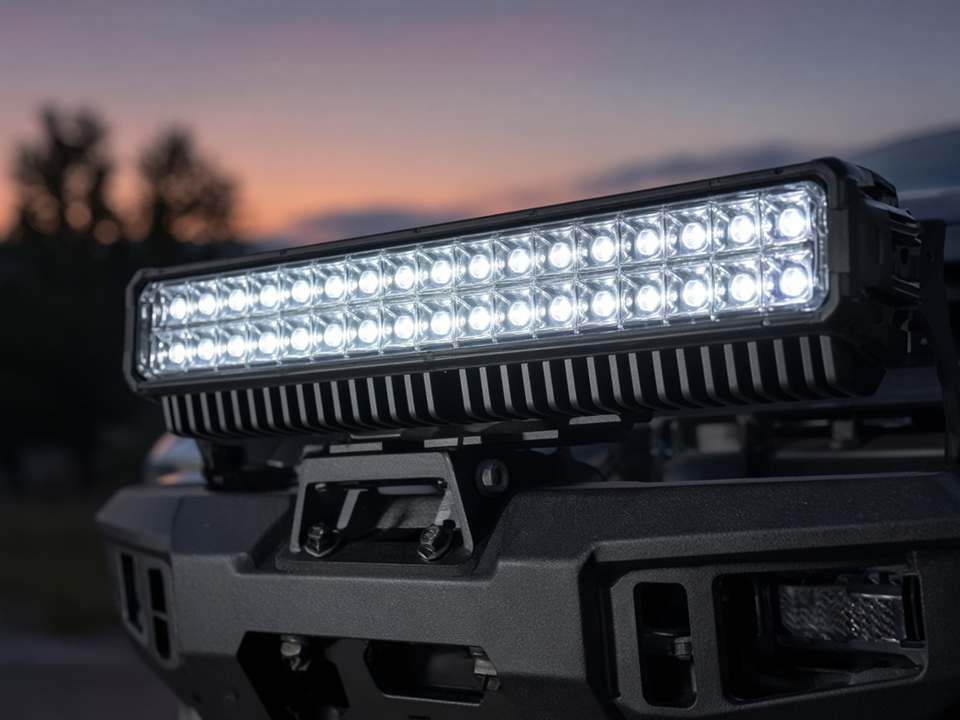
Cube or pod lights (often 2–4 inches square or round) mount on bumpers, A-pillars, hoods and winch fairleads. They are easy to aim one job at a time: a spot pod far ahead, a flood pod beside the trail. Ditch lights are pods on A-pillar or hood mounts aimed outward so the driver can see the ditch or berm without turning the steering wheel. Fog-light replacements drop into the factory fog pockets and usually use a wide, low beam. Rock lights are small sealed pods under the rockers and bumpers for crawling. Chase or dust lights face rearward so following vehicles can see you in a dust cloud. Camp and scene floods light a wide area around a parked vehicle.
| Type | Typical mount | Best for |
|---|---|---|
| Straight / curved light bar | Bumper, grille, roof, windshield | Primary forward fill on open trails |
| Cube / pod | Bumper, A-pillar, hood, fairlead | Aimable fill, corners, modular setups |
| Ditch / A-pillar | A-pillar or hood brackets | Roadside berms and washouts |
| Fog replacement | Factory fog pocket | Low, wide beam in weather |
| Rock light | Underbody, rocker, bumper | Wheel placement while crawling |
| Chase / dust | Rear bumper, tire carrier | Being seen in dust by followers |
| Camp / scene flood | Roof, side, rear | Work and camp light while parked |
Spot vs. flood vs. combo beam: which one do you actually need?
A spot or pencil beam throws a narrow cone far ahead for open trails and high speed. A flood or scene beam spreads wide and short for camping, winching and tight woods. A combo or driving beam mixes both in one housing and is the usual first choice for a single bumper or roof bar.
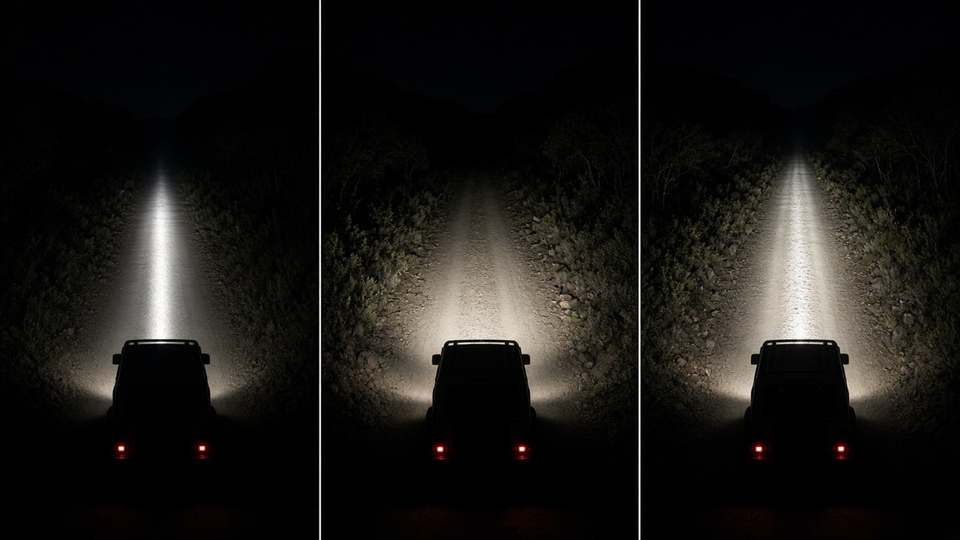
Optics decide the pattern. Many modern pods and bars use TIR (total internal reflection) lenses molded over each LED, which control the beam tightly and waste less light sideways. Older and some high-power designs use polished reflector cups behind a clear or fluted cover. Neither is automatically better; match the published beam chart to the trail. Manufacturers often quote a 1-lux distance for spot beams (roughly the edge of useful seeing for many drivers) and a horizontal spread in degrees for floods.
| Pattern | Distance | Width | Best use |
|---|---|---|---|
| Spot / pencil | Long (often 300–800+ m at 1 lux on large bars) | Narrow | Desert, fire roads, spotting obstacles early |
| Flood / scene | Short to medium | Wide (often 60–120°+) | Woods, camp, work light, rock crawling near field |
| Combo / driving | Medium-long | Medium with a brighter center | Daily trail bar when you can only fit one pattern |
A practical setup on many trucks is a combo or driving bar on the bumper, flood pods as ditch lights, and a rear flood or amber chase light. Roof bars throw farther but can glare in fog and dust because the light starts higher; bumper mounts stay lower, which helps in weather.
Amber vs. white off-road lights: which performs better in dust and fog?
On clear trails, 5700–6500 K white gives crisp contrast and long throw. In dust, fog, rain and snow, 2700–3200 K amber or selective yellow usually feels easier on the eyes because it cuts blue-rich glare from backscattered particles, not because yellow light magically penetrates farther through the cloud.
Fog and dust droplets are much larger than the wavelength of visible light, so they scatter all colors roughly equally (Mie scattering). The common claim that yellow “cuts through” fog better than white is therefore overstated. What does change is how your eyes handle the backscatter: shorter blue wavelengths contribute more to glare and make floating particles more distracting. Selective yellow (a SAE/ECE fog color that removes much of the blue) and warm amber filters reduce that load. Many drivers run white for clear nights and switch amber covers or amber pods when the trail gets dusty.
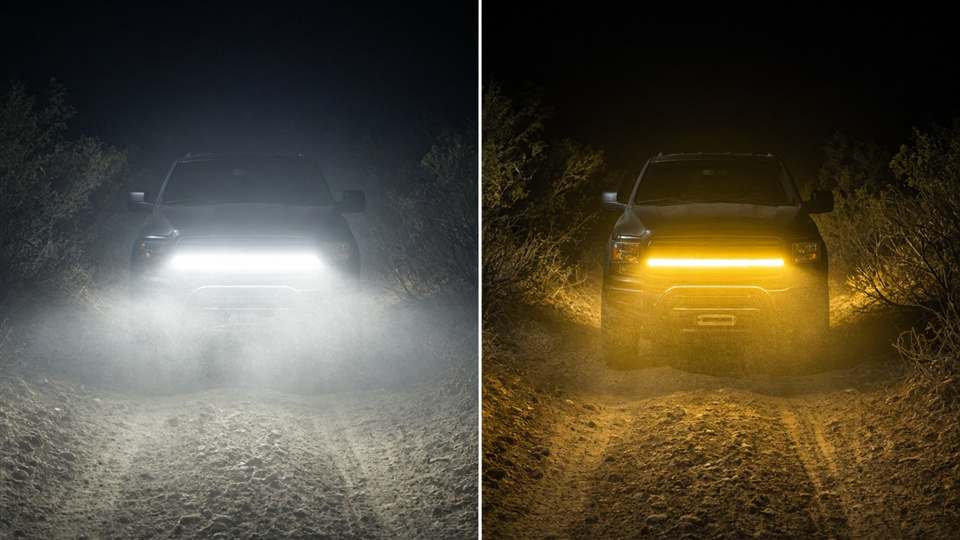
For factory-style fog lamps, SAE J583 allows white or selective yellow. Forward-facing blue, purple and green are almost always illegal on public roads and reserved for emergency or specialty uses. Check your state rules before leaving amber ditch lights uncovered on the highway.
How durable should off-road lights be, and what do the lumen numbers mean?
Treat IP67 as the practical minimum for trail lights: dust-tight and safe in temporary immersion about a metre deep. IP68 means continuous immersion under maker-stated conditions. Prefer “effective” or measured lux/candela figures over huge “raw lumen” claims, and look for a real aluminium heat path so the LEDs do not cook themselves.
Raw lumens are usually the sum of LED chip ratings on a datasheet. Effective lumens try to account for lens, reflector and thermal losses and are closer to what you see, though brands define the term differently. A candela (cd) peak and a 1-lux distance chart are more useful for comparing throw. Housing fins or a thick aluminium body dump heat; plastic-backed “high watt” bars often dim after a few minutes as the driver throttles current. Polycarbonate or hardened glass lenses survive rock chips better than thin acrylic. Rubber isolators and stainless hardware help against vibration on corrugated roads.
How should you wire a light bar or pod kit on 12 V?
Run a fused positive cable from the battery to a relay near the lights, switch the relay coil from a dash switch or controller, and ground the lights to clean bare metal. Size wire for the current and length, use sealed connectors outdoors, and never put a high-current bar through a thin factory switch alone.
12 V light-bar relay harness
A typical harness is battery → fuse → relay common, relay output → light positive, light negative → chassis ground, and a low-current switch that energizes the relay coil. Dual-battery or ignition-switched feeds keep accessories from draining the starting battery. Deutsch DT or similar sealed plugs beat bare crimps in mud. For long roof runs, thicker cable limits voltage drop; the wire-gauge notes on the strip calculator apply the same 12 V arithmetic. Leave drip loops so water does not follow the loom into connectors.
Are LED light bars street-legal, or off-road only?
Most aftermarket light bars are sold for off-road use only and must be covered or switched off on public roads. Street-legal auxiliaries are usually SAE J581 driving lamps used with high beam, or SAE J583 fog lamps used with low beam, aimed so they do not hide required lights, subject to each state's color and height rules.
U.S. Federal Motor Vehicle Safety Standard 108 sets rules for required lamps (headlamps, signals and so on) but does not fully specify auxiliary driving and fog lamps the way it specifies headlamps. NHTSA has long said states regulate those auxiliaries, while federal law still forbids anything that impairs required lighting. SAE J581 and J583 are voluntary performance practices manufacturers use for “SAE” marked driving and fog lamps; they are not a federal “approval” stamp. A “DOT approved light bar” label on a generic bar is often marketing. In Europe, an E-mark on an auxiliary lamp points to a UN regulation path. When in doubt, use covers on pavement, aim below eye level of oncoming drivers, and read your state vehicle code.
Frequently asked questions
Do I need a curved or a straight light bar?
Straight bars are simpler and usually cheaper. Curved bars follow some bumper and grille shapes and can keep more light out of the side mirrors. Beam quality and mount strength matter more than the curve.
Single-row or dual-row light bar?
Dual-row packs more LEDs into a given length and can be brighter, but it is taller, heavier and harder to cool. A well-designed single-row with good optics often throws farther than a cheap dual-row of the same wattage.
Why do my LEDs look dim after a few minutes?
Thermal foldback. As the housing heats up, the driver reduces current to protect the chips. Better heat sinks and honest power ratings hold output longer.
Can I use off-road pods as fog lights?
Only if they are aimed low, have a wide cut-off suitable for fog, and are legal as fog lamps where you drive (often SAE J583 style). A bright roof flood aimed into fog will mostly light the cloud in front of you.
What color temperature should trail lights be?
About 5700–6500 K white for clear, dry trails; about 2700–3200 K amber or selective yellow when dust, fog, rain or snow creates backscatter glare.
Is IP67 enough for creek crossings?
IP67 covers temporary immersion around a metre for about 30 minutes under typical test wording. Deep or long soaks need IP68 with the maker’s depth and time stated, plus intact seals and connectors.
Will a light bar drain my battery?
A large bar can draw 10–40 A. Use a fused relay harness, switch lights off with the engine, and consider a dual-battery or DC-DC charger if you idle with many accessories on.
Where do rock lights and chase lights fit?
Rock lights belong under the vehicle for wheel placement at crawl speed. Chase or dust lights face rearward so the vehicle behind can track you in powder dust; amber is common for that job.
Sources and further reading
- NHTSA interpretation letters on auxiliary driving and fog lamps and FMVSS 108 (e.g. 13434.ztv, 17338.ztv): federal limits, state role, and impairment of required lamps.
- SAE J581, auxiliary driving lamps; SAE J583, front fog lamps; SAE J578, color specification (including selective yellow).
- IEC 60529, Degrees of protection provided by enclosures (IP Code) (IP67 / IP68).
- Bullough, J.D., and Rea, M.S., research on headlamp spectrum and glare; practical summaries in Stern, D., “Light Color” technical notes on selective yellow and Mie vs Rayleigh scattering in fog.
- Manufacturer application notes on TIR vs reflector optics and SAE fog/driving markings (e.g. Diode Dynamics, KC HiLiTES support articles).
Image credits
- Trail night scene, light-bar close-up, spot vs flood vs combo, and amber vs white dust comparison: AI-generated illustrations for LEDlights.org.
- Relay harness wiring diagram: LEDlights.org.