H11 vs 9005 vs 9006 bulbs
Three single-filament headlight and fog bulbs that look alike but do not interchange
H11, 9005 and 9006 are single-filament halogen headlight bulbs. The 9005, also called HB3, is a 60 W high-beam bulb; the 9006, or HB4, is a 51 W bulb for low beams and fog lamps; and the H11 is a 55 W low-beam and fog bulb on an L-shaped base. Each has its own base, so they do not interchange.
Open the hood of many cars built since the 1990s and you will find two of these three bulbs: a 9005 for the high beam and an H11 or a 9006 for the low beam, sometimes with another in the fog lamps. They look alike, and plug-in LED versions are sold for all three, but the bases are deliberately different, and the rules on LED versions are stricter than the packaging suggests.
Which is high beam, low beam and fog?
9005, also called HB3, is a high-beam bulb of 60 W. 9006, or HB4, is a 51 W bulb for low beams and fog lamps. H11 is a 55 W bulb for low beams and fog lamps, common in projector headlights. Many cars pair a 9005 high beam with an H11 or 9006 low beam.
| Bulb | Also called | Base | Power | Light output | Typical use |
|---|---|---|---|---|---|
| H11 | None | PGJ19-2 | 55 W | 1,350 lm | Low beam, fog |
| 9005 | HB3 | P20d | 60 W | 1,700 lm | High beam |
| 9006 | HB4 | P22d | 51 W | 1,000 lm | Low beam, fog |
US catalogs list the 9005 at 65 W and the 9006 at 55 W because they rate bulbs at 12.8 V rather than 12 V; the bulbs are the same. Lumens are the bulb's total output. How much of it reaches the road, and where, depends on the reflector or projector designed around the filament.
Variants share the names. The 9005XS and 9006XS, also called HB3A and HB4A, have a straight base with the connector pointing backward instead of turning 90°; use the version the headlamp was designed for. The 9011 and 9012 (HIR1 and HIR2) are brighter relatives with a coating that reflects infrared back onto the filament. They have their own bases and are not drop-in replacements.
Can you swap H11, 9005 and 9006?
No. Each has its own base tabs and flange, so a different bulb will not lock into the headlamp. 9005 and 9006 look almost identical, and some people file the tabs to force a swap, but the filament is then no longer where the reflector expects it, which causes glare or a dim, scattered beam.
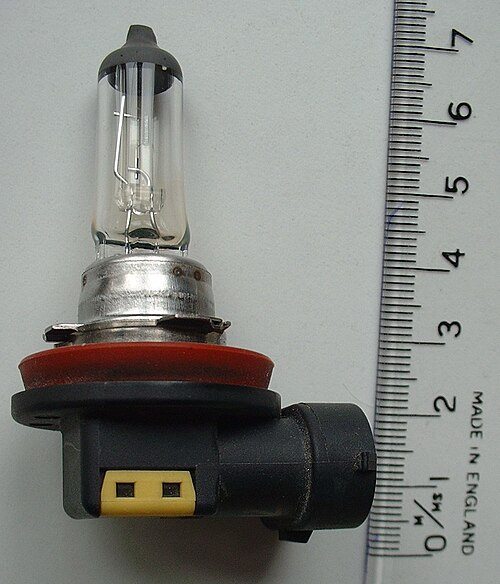

The H11 belongs to a family of bulbs on PGJ19 bases: the H8 (35 W, 800 lm) for fog lamps, the H9 (65 W) for high beams, the H11 (55 W) and the H16 (19 W) for fog lamps. The plastic tabs differ for each, so a hotter H9 cannot be fitted where an H11 belongs. Types ending in B, such as the H11B, use the PGJY19 base, which has different tabs again.
The same logic separates the 9005 from the 9006: the 60 W high-beam bulb is keyed so it cannot go into a low-beam housing built for 51 W. Filing the tabs defeats that, and the extra 9 W adds heat the housing was not designed for.
Are LED H11, 9005 and 9006 bulbs legal?
In the United States, no: NHTSA says no LED light source is permitted in a replaceable-bulb headlamp. In UNECE countries, only approved LED substitutes are legal, and only in vehicles their maker lists: H11/LED since 2024, with fog-lamp versions of H8, H16 and HB4 adopted in 2026. No LED 9005 substitute exists.
The US position is set out in a 2023 NHTSA interpretation letter: a replaceable headlamp bulb must match specifications filed under 49 CFR Part 564, and no LED bulb has been filed. Kits that put an LED into a halogen headlamp therefore cannot lawfully be sold, although installation by owners is left to state law.
The UNECE route is UN Regulation 128, with the light-source sheets in Resolution R.E.5. An H11/LED substitute must reproduce the halogen bulb's beam in the headlamps it was approved with, and it has a different connector from a halogen H11, to prevent misuse. Bulb makers publish lists of the vehicles each substitute is approved for.
The reason is optical. A reflector or projector is shaped around a filament of a precise size and position, while LED chips emit from flat surfaces on a board. An untested LED bulb in the same housing can throw light above the cutoff into oncoming drivers' eyes, or leave the road dimmer than before. For LED light designed in from the start, the alternative is a complete headlamp certified as an LED unit; see LED replacement bulbs and complete LED headlamps.
Choosing a replacement bulb
Read the code on the old bulb's base or in the owner's manual, and replace halogen bulbs in pairs, because the other one is near the end of its life too. Long-life versions last longer but give less light; high-performance versions are brighter but burn out sooner. Never fit a higher wattage than the headlamp specifies.
Handle halogen bulbs by the base: skin oil left on the quartz glass creates hot spots that can crack it. Check the aim after replacing a bulb, especially if the beam looks higher than before. If a new bulb fails within weeks, look for a corroded or melted connector, which another bulb will not fix.
Frequently asked questions
Is 9005 the same as HB3?
Yes. 9005 is the North American number and HB3 the international name for the same 60 W high-beam bulb. Likewise, 9006 and HB4 are the same 51 W bulb.
Can I use a 9005 bulb instead of a 9006?
Not without filing its tabs, and you should not. The 9005 draws more power, and its filament is not where the low-beam reflector expects it, which can dazzle other drivers.
Are H8, H9, H11 and H16 interchangeable?
No. They share a family of L-shaped bases but differ in tabs and wattage: H8 is 35 W, H9 65 W, H11 55 W and H16 19 W. Use the type the lamp specifies.
What do 9005XS and 9006XS mean?
They are straight versions of the 9005 and 9006, also called HB3A and HB4A, with the connector pointing straight back instead of turning 90°. Use whichever the headlamp was designed for.
Why do my headlight bulbs keep burning out?
Common causes are skin oil on the glass, a loose or corroded connector, water inside the headlamp, and high-performance bulbs, which trade lifespan for light.
Sources and further reading
- UN Regulation No. 37, uniform provisions for filament light sources in approved vehicle lamps, with category sheets in the Consolidated Resolution R.E.5 (H8, H9, H11, H16, HB3 and HB4).
- UN Regulation No. 128, LED light sources, and R.E.5 Group 4, LED substitute light source categories; ECE/TRANS/WP.29/2024/156 (H11/LED).
- 49 CFR Part 564, Replaceable Light Source and Sealed Beam Headlamp Information, and FMVSS No. 108, 49 CFR 571.108.
- NHTSA Office of Chief Counsel, interpretation letter on LED headlights to M. Baker (NCC-230201-001), 2023.
Image credits
- 9006 bulb: ogyp, CC BY-SA 3.0. H8 bulb: David H Payne, CC0. Both via Wikimedia Commons.