G9 LED bulbs
The looped-pin capsule lamp in chandeliers, wall lights and bathroom fittings
A G9 base has two looped wire pins 9 mm apart and pushes straight into its socket. It is used on small mains-voltage capsule lamps, originally halogen, in chandeliers, wall lights, bathroom fittings and cooker hoods. LED G9 lamps replace them, but must fit a driver into a body not much bigger than a fingertip.
Halogen G9 capsules made compact, sparkling fixtures possible: a glass bulb not much bigger than a thumbnail, running straight from the mains. Replacing them with LED is harder than replacing a household bulb, because the electronics must fit in the same tiny space and survive the heat inside an enclosed glass shade. Done well, the swap cuts the power by roughly 85–90%.
What is a G9 bulb?
A G9 is a small capsule lamp with two looped pins 9 mm apart that push straight into the socket. It runs directly on mains voltage, 120 V or 230 V, with no transformer. Halogen G9 capsules range from about 18 to 60 W; LED replacements typically use 2–5 W for similar light.
Common lamp bases, drawn to the same scale
10 mm
Because the pins are loops rather than solid pegs, the socket holds a G9 lamp with spring contacts that grip the loops. Pull it straight out to remove it; do not twist. Handle halogen capsules with a cloth or glove, because skin oil left on the quartz glass can cause hot spots that shorten its life.
Why LED G9 bulbs are tricky
An LED G9 must fit a mains driver, LEDs and a heat path into a capsule about 16 mm across, so cheap ones cut corners. Common problems are visible flicker, poor dimming, a body too long for the shade, and early failure from heat inside enclosed glass. Buy from makers that state flicker and dimming performance.
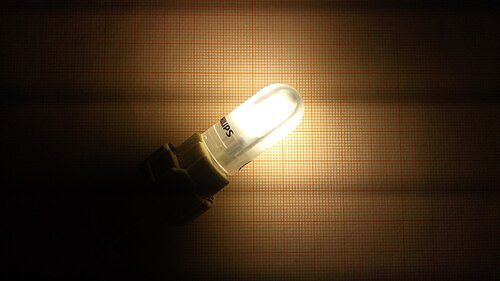

- Size: halogen G9 capsules are about 13–14 mm across and 45 mm long; many LED versions are wider and longer. Measure the space inside the shade before buying.
- Flicker: the smallest drivers often skimp on smoothing, so the light ripples at twice the mains frequency, 100 or 120 times a second. A phone camera shows it as dark bands (see LED drivers and flicker).
- Dimming: only lamps marked dimmable will dim, and the dimmer must suit LED loads.
- Heat: enclosed glass shades trap heat. Where the maker rates a lamp for enclosed fixtures, choose that one.
G9 vs G4, G8 and GY6.35
Capsule lamps share a family of bi-pin bases named by pin spacing. G9 is the mains-voltage loop-pin capsule. G4 and GY6.35 have straight pins and run on 12 V, the G4 for small cabinet and landscape lights, GY6.35 for higher wattages. G8 is a North American 120 V capsule for under-cabinet fixtures.
| Base | Pins | Pin spacing | Voltage | Typical uses |
|---|---|---|---|---|
| G4 | Straight, thin | 4 mm | 12 V | Cabinet, cooker-hood and landscape lights |
| GY6.35 | Straight, thicker | 6.35 mm | 12 V (some 24 V) | Desk lamps, pendants, display lighting |
| G8 | Straight | 8 mm | 120 V | Under-cabinet and pendant lights (North America) |
| G9 | Looped | 9 mm | 120 V or 230 V | Chandeliers, wall lights, bathroom fittings |
The different pins keep 12 V and mains lamps apart: a 12 V G4 capsule cannot go into a mains G9 holder. If an old capsule is unmarked, measure the distance between the pin centers.
Choosing an LED G9
Check four things: the length and width against the space in the shade, a color temperature of 2700–3000 K to match halogen, the word dimmable if the light is on a dimmer, and a stated flicker performance. In enclosed glass shades, pick lamps the maker rates for enclosed fixtures.
Brightness is listed in lumens. Compare the lumens on the packaging rather than "equivalent" watts, which vary between brands, and choose CRI 90 or higher if the fixture lights a mirror or a dining table (see CRI and color temperature).
Frequently asked questions
Are G9 bulbs mains voltage?
Yes. G9 lamps run directly on 120 V or 230 V mains with no transformer, unlike 12 V G4 and GY6.35 capsules.
Why are LED G9 bulbs bigger than halogen ones?
The LED version must hold a mains driver and spread its heat, which takes more space than a halogen filament. Check the length and width before buying.
Can I use an LED G9 on a dimmer?
Only if it is marked dimmable and the dimmer suits LED loads. Non-dimmable lamps on a dimmer can flicker, buzz or fail early.
Can a G9 bulb go in a G4 socket?
No. The pins are spaced and shaped differently, and the voltages differ: G9 is mains, G4 is 12 V.
Why do my G9 LED bulbs flicker?
Usually a minimal driver without enough smoothing, or a dimmer that does not suit LED loads. Better-made lamps with flicker-free drivers solve it.
Sources and further reading
- IEC 60061-1, Lamp caps and holders together with gauges for the control of interchangeability and safety: Lamp caps (G9, G4 and GY6.35 caps).
- IEC 60357, Tungsten halogen lamps (non-vehicle): Performance specifications.
- IEC 62560, Self-ballasted LED lamps for general lighting services by voltage > 50 V: Safety specifications.
- IEEE 1789-2015, Recommended Practices for Modulating Current in High-Brightness LEDs for Mitigating Health Risks to Viewers.
- NEMA SSL 7A-2015, Phase-Cut Dimming for Solid State Lighting: Basic Compatibility.
Image credits
- G9 pins: Sandstein, CC BY-SA 4.0. LED G9 flicker: Dmitry G, CC BY-SA 3.0. Both via Wikimedia Commons. Base chart: LEDlights.org.