H4 vs H7 headlight bulbs
One bulb for both beams, or one bulb for each
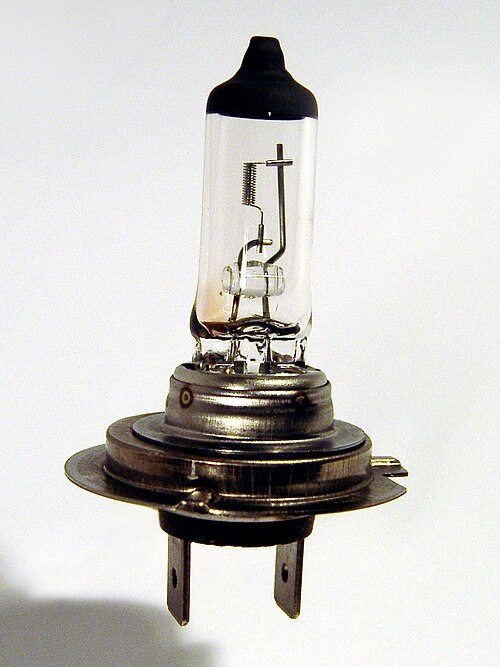
H4 and H7 are two of the most widely used halogen headlight bulbs. An H4 has two filaments, giving the low and the high beam from one bulb; an H7 has one filament, so headlamps that use it need a separate bulb for each beam. Their bases, P43t and PX26d, do not interchange.
The H4 is a halogen bulb with both beams in one capsule, the layout of most single-headlamp cars for decades. The H7 came later, as designers moved to separate reflectors or projectors for each beam and wanted a compact single-filament bulb. Which one a car uses is decided by its headlamps, not by the driver, and the same goes for whether an LED version is allowed.
What is the difference between H4 and H7?
An H4 holds two filaments, so one bulb gives both the low and the high beam; it has three terminals on a P43t base. An H7 has one filament and two terminals on a PX26d base, so a headlight with H7 bulbs needs a second bulb, often another H7 or an H1, for the other beam.

Inside an H4, the low-beam filament sits slightly ahead of the high-beam one, above a small metal shield. The shield blocks the light that would otherwise reach the lower half of the reflector and be thrown upward, which gives the low beam its sharp cutoff. An H7 headlamp gets its cutoff from the reflector or projector instead.
North America has its own dual-filament bulbs that do the H4's job on different bases: the 9004 (HB1), 9007 (HB5) and 9008 (H13). The 9003, also called HB2, is an H4 made to tighter tolerances, and the two interchange.
| Bulb | Filaments | Base | Power | Light output | Typical use |
|---|---|---|---|---|---|
| H1 | 1 | P14.5s | 55 W | 1,550 lm | High beam, fog |
| H3 | 1 | PK22s | 55 W | 1,450 lm | Fog and auxiliary lamps |
| H4 | 2 | P43t | 60/55 W | 1,650/1,000 lm | Both beams in one bulb |
| H7 | 1 | PX26d | 55 W | 1,500 lm | Low or high beam |
| H13 (9008) | 2 | P26.4t | 60/55 W | 1,700/1,100 lm | Both beams, mainly North America |
Can an H7 replace an H4?
No. The bases, terminals and filament positions differ, so neither bulb fits the other's headlamp, and adapters that force a fit produce a badly aimed beam. A headlamp designed for H4 needs H4 bulbs, and one designed for H7 needs H7s. Check the code on the old bulb, the headlamp housing or the owner's manual.
The flanges are what make the difference. An H4's P43t flange has three tabs of different widths, so it seats in only one position; an H7's PX26d flange is clamped by a spring clip or held in a twist-in socket. Either way, the filament must end up within a fraction of a millimeter of where the headlamp designer put it.
Which LED H4 and H7 bulbs are legal?
In the United States, none: no LED bulb is permitted in a replaceable-bulb headlamp. In Germany, the KBA has approved a few LED H7 and H4 bulbs, such as Osram's Night Breaker LED and Philips' Ultinon Pro6000, for listed car models only. UN Regulation 128 does not yet include H4 or H7 LED substitutes.
The German approvals began in autumn 2020 with Osram's Night Breaker H7-LED, followed by H4 and H1 versions and, from 2021, Philips' Ultinon Pro6000 in H7 and H4. Each covers only the car models on the maker's list, and the approval certificate has to be carried in the car. Approvals are vehicle-specific because the beam depends on the bulb and the reflector together: an LED bulb that matches a halogen H7's beam in one headlamp may cause glare in another.
In the United States, the 2023 NHTSA interpretation applies to H4 and H7 as to every replaceable headlamp bulb: no LED bulb is listed under 49 CFR Part 564, so none is permitted. The legal route to LED headlights there is a complete headlamp certified as an LED unit (see LED replacement bulbs).
Choosing H4 and H7 bulbs
Fit the type the headlamp specifies, replace bulbs in pairs, and choose between standard, long-life and high-performance versions, remembering that brighter versions trade lifespan for light. Keep to the rated wattage: 100/90 W H4 bulbs are sold for off-road use, and can overheat headlamps and wiring designed for 60/55 W.
Blue-tinted halogen bulbs use a coating that filters out some yellow light, so they give less light overall, and strongly blue tints can fall outside the color allowed for headlamps. Handle the glass only through a cloth or by the base, and check the beam aim after the change.
Frequently asked questions
Is H4 the same as 9003?
Almost. The 9003, also called HB2, is an H4 made to tighter tolerances for North America, and the two interchange.
Does an H7 bulb do high and low beam?
No. An H7 has one filament. Cars with H7 low beams use a separate bulb for the high beam, often another H7, an H1 or an H9.
Why does one beam of my H4 work but not the other?
Each filament can fail on its own. If the low beam is out but the high beam works, the low-beam filament has broken: replace the bulb, and ideally the one on the other side too.
Are 100/90 W H4 bulbs legal?
Not for road use in most countries. They exceed the 60/55 W rating, put more heat into the headlamp and its wiring, and are sold for off-road use.
Is an H7 brighter than an H4?
On paper, the H7's 1,500 lumens beat the H4's 1,000-lumen low beam, but the headlamp matters more than the bulb: a well-designed H4 reflector can light the road better than a poor H7 one.
Sources and further reading
- UN Regulation No. 37, uniform provisions for filament light sources in approved vehicle lamps, with category sheets in the Consolidated Resolution R.E.5 (H1, H3, H4, H7 and H13).
- 49 CFR Part 564, Replaceable Light Source and Sealed Beam Headlamp Information, and FMVSS No. 108, 49 CFR 571.108.
- NHTSA Office of Chief Counsel, interpretation letter on LED headlights to M. Baker (NCC-230201-001), 2023.
- Kraftfahrt-Bundesamt, general type approvals (ABG) under §22a StVZO for LED retrofit lamps, with the makers' vehicle lists (Osram Night Breaker LED, Philips Ultinon Pro6000).
- UN Regulation No. 128, LED light sources, and R.E.5 Group 4, LED substitute light source categories.
Image credits
- H4 bulb: MattiPaavola, CC BY-SA 3.0. H7 bulb: btr, CC BY-SA 2.5, cropped. Both via Wikimedia Commons.