Solar garden lights
How they work, why they fade in winter, and how to get the most from them
A solar garden light is a self-contained outdoor light with a small solar panel, a rechargeable cell and an LED. The panel charges the cell by day and doubles as the dark sensor: when its voltage falls at dusk, a driver chip switches the LED on and runs it from the cell for as long as the charge lasts.
Solar lights are the easiest outdoor lights to install and the hardest to judge, because how long they shine depends on the season, the latitude and the spot you choose more than on the light itself. This guide explains the circuit inside, works through the winter numbers for seven cities, and covers batteries, placement and faults.
How a solar garden light works
By day, the panel charges a single 1.2 V nickel-metal hydride cell through a diode. At dusk the panel's voltage falls, and a small chip such as the QX5252 starts a boost converter, switching an inductor hundreds of thousands of times a second to lift the cell's 1.2 V to the 3 V or so a white LED needs.
The QX5252F, one of the most common chips, has four pins: the panel's positive lead goes to one, the cell to another, ground to the third, and the inductor runs from the cell to the fourth, where the LED also connects. Its datasheet specifies a built-in Schottky diode, about 83% conversion efficiency, a standby current of 17 µA, and an over-discharge cutoff at 0.9 V that protects the cell. It switches the LED off when the panel rises above 0.37 V and on when it falls below 0.29 V, so the panel is also the light sensor. The same boost principle runs the "joule thief" circuits hobbyists build to light an LED from a single cell.
The inductor sets the brightness. The datasheet's table for a single LED runs from 5.3 mA drawn from the cell with a 220 µH inductor to 46.8 mA with 22 µH:
| Inductor | Current from the cell |
|---|---|
| 220 µH | 5.3 mA |
| 150 µH | 7.9 mA |
| 82 µH | 13.9 mA |
| 68 µH | 18.2 mA |
| 47 µH | 25.4 mA |
| 22 µH | 46.8 mA |
A brighter light needs a bigger panel and cell to match. Swapping in a smaller inductor makes a light brighter, but it shortens the night it can cover.
Inside a solar garden light
Why solar lights fade in winter
Winter hits a solar light twice: the panel gets far less sun, and the night it must cover is twice as long. At London's latitude, December brings about one-eighth of June's daily sunlight on a flat panel and more than twice the darkness, leaving about one-seventeenth as much energy for each hour of night.
| City | Summer sun | Winter sun | Summer night | Winter night | Winter energy per dark hour |
|---|---|---|---|---|---|
| Phoenix | 8.41 | 3.10 | 9.6 h | 14.1 h | 1/4 |
| Atlanta | 6.22 | 2.27 | 9.6 h | 14.1 h | 1/4 |
| Sydney | 6.78 | 2.37 | 9.6 h | 14.1 h | 1/4 |
| Chicago | 6.64 | 1.53 | 8.8 h | 14.9 h | 1/7 |
| Seattle | 5.49 | 0.82 | 8.0 h | 15.6 h | 1/13 |
| London | 5.29 | 0.67 | 7.4 h | 16.2 h | 1/17 |
| Berlin | 5.75 | 0.54 | 7.2 h | 16.4 h | 1/24 |
Sunlight is the European Commission's PVGIS average for June and December, 2005–2023, reversed for Sydney, where winter is June; the figures include cloudy days. One kilowatt-hour per square meter is the equivalent of one hour of full sun. Night is sunset to sunrise at the solstice. The last column divides one ratio by the other: a December night in Chicago gets about one-seventh of the energy per hour that a June night does, and in Berlin about one twenty-fourth.
Cold adds a third penalty. Panasonic specifies charging its nickel-metal hydride cells between 0 and 45 °C, and Energizer notes that capacity falls significantly below freezing. The low winter sun also casts long shadows, so a spot that is sunny in June may be shaded all day in December.
A worked example: one light, two seasons
Take a light whose panel gives 60 mA in full sun, driving an LED that draws 20 mA from the cell, in London. In June it collects about 320 mAh a day and needs 150 mAh for the night. In December it collects about 40 mAh, enough for two hours, against the 320 mAh a 16-hour night would need.
| Case | Charge per day | Needed for the night | Light |
|---|---|---|---|
| June, flat panel | 317 mAh | 148 mAh | All night |
| December, flat panel | 40 mAh | 324 mAh | 2.0 h |
| December, panel tilted 60° | 98 mAh | 324 mAh | 4.9 h |
The arithmetic works because a small crystalline panel charging a 1.2 V cell runs close to its short-circuit current, which is proportional to the light falling on it. Each kilowatt-hour per square meter of daily sunlight is therefore worth about one hour of the panel's full-sun current: 5.29 × 60 mA ≈ 317 mAh in June and 0.67 × 60 mA ≈ 40 mAh in December. Tilting the same panel 60° toward the south raises London's December sunlight to 1.64 kWh/m² a day in PVGIS, worth about 98 mAh, or five hours of light: the single most effective fix, where a light has a separate panel that can be aimed. A larger cell does not help in December, because the cell never fills; it only helps carry summer surplus through a cloudy day.
Batteries: NiMH, never alkaline
Garden lights use a single rechargeable 1.2 V nickel-metal hydride cell, usually AA or AAA. Replace it with another NiMH cell of the same size; an alkaline cell cannot be recharged and may leak. Cells often need replacing after about a year, and they charge poorly in frost: Panasonic specifies charging between 0 and 45 °C.
Below 0 °C, Panasonic warns, a nickel-metal hydride cell cannot absorb the gas that charging produces, which risks venting and leaks; Energizer notes that capacity falls significantly below freezing. Older lights may use nickel-cadmium cells, which are replaced the same way. A higher-capacity NiMH cell is fine, but it will not lengthen a December night, for the reason the worked example shows. Larger solar floodlights and wall lights use lithium-ion packs instead: Cooper Lighting's HALO solar floodlight, for example, has a lithium-ion NMC battery rated for 300 cycles.
Placement, first charge and cleaning
Put solar lights where the panel gets direct sun most of the day, at least eight hours if the maker asks for it, away from porch lights and streetlights that the panel would read as daylight. Keep the panel clean, follow the maker's first-charge instructions, and in winter, move lights out of the long shadows.
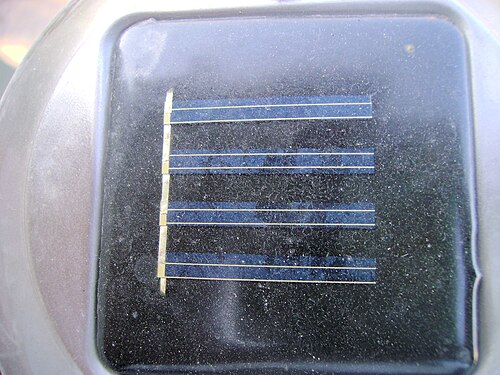

First-charge instructions differ because switches differ: on some lights the switch disconnects only the LED, so the cell charges while the light is switched off, and on others it disconnects the cell, so the light must be switched on to charge. Manuals commonly ask for two days of sun before first use. Where the panel is separate, face it toward the equator, south in the Northern Hemisphere, and tilt it steeply for winter. A quick test needs no sun: cover the panel with a hand or a cloth, and a working light should switch on within a few seconds, because the panel is its dark sensor.
Troubleshooting solar lights
If a solar light never comes on, check the switch, the battery and any nearby lights the panel can see. If it fades early, suspect winter sun, shade, a dirty panel or a worn-out cell. If it stays on in daylight, the panel's wire has probably broken, so the chip sees permanent darkness.
| Symptom | Likely cause | Fix |
|---|---|---|
| Never comes on | Switched off, pull-tab still in place, dead cell, or a porch light or streetlight on the panel | Switch on, remove the tab, fit a charged NiMH cell, or move the light |
| On for only an hour or two | Winter sun, shade or a dirty panel | Move it into full sun, clean the panel, tilt a separate panel toward the sun |
| Dim or dies early all year | A worn-out cell | Replace it with a NiMH cell of the same size |
| Stays on in daylight | A broken or corroded panel connection | Repair the panel wire, or replace the light |
| Works only after sunny days | Panel and cell small for the LED | Expected; choose lights with larger panels for all-night use |
Frequently asked questions
Why do my solar lights only last a few hours?
In winter that is normal: far less sun and much longer nights. In London a flat panel collects about one-eighth of June's daily sunlight in December, for a night more than twice as long. Shade, a dirty panel and an old cell make it worse.
Can I put regular AA batteries in solar lights?
No. Use rechargeable NiMH cells of the same size. Alkaline cells cannot be recharged and may leak or swell when the panel tries to charge them, and 3.7 V lithium-ion cells in the AA size have the wrong voltage.
Do solar lights charge on cloudy days?
Yes, but much less, because the charging current follows the light on the panel. The monthly sunlight figures on this page already include cloudy days.
Should I turn solar lights off to charge them?
It depends on the design. On some lights the switch disconnects only the LED, so the cell charges while the light is off; on others it disconnects the cell, so the light must be on to charge. Follow the maker's instructions, especially for the first charge.
Do solar lights work in winter?
Yes, but for fewer hours, especially far from the equator: in Berlin a December night gets about one twenty-fourth of the energy per hour that a June night does. Lights with a separate panel tilted toward the sun do much better.
Sources and further reading
- European Commission Joint Research Centre, PVGIS 5.3: monthly horizontal and inclined-plane irradiation, 2005–2023 (PVGIS-SARAH3 for London and Berlin, PVGIS-ERA5 for the other cities).
- Night lengths: calculated by LEDlights.org for the solstices (solar declination ±23.44°, sun's center 0.833° below the horizon at sunrise and sunset).
- QX Micro Devices, QX5252F solar LED driver datasheet (distributor copy, Conrad Electronic).
- Panasonic, nickel-metal hydride batteries technical handbook (charging temperature); Energizer, nickel-metal hydride handbook and application manual.
- Cooper Lighting Solutions, HALO solar LED floodlight specifications.
- Garden-light manufacturers' instructions: first charge, battery type, placement and replacement.
Image credits
- Solar garden light: Leon Brooks, public domain. Solar panel close-up: Yousaf465, CC BY 3.0. Both via Wikimedia Commons. Circuit diagram: LEDlights.org.