Motion-sensor lights: PIR vs microwave
How the sensors see you, how to aim and set them, and how to stop false triggers
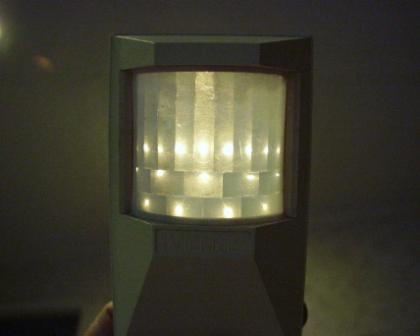
A passive infrared (PIR) sensor detects motion by sensing changes in the heat radiation reaching it. It emits nothing: a segmented lens divides its view into zones, and a warm body moving from zone to zone produces a changing signal that switches the light on.
A motion-sensor light is a light with a very particular kind of eye. Most use passive infrared, which sees warm bodies only when they move across its zones, so placement and aiming decide whether it catches a visitor at the gate or a cat on the fence. This guide explains the sensor, range and mounting, microwave alternatives, the settings, false triggers, and LEDs that glow when they should be off.
How a PIR sensor sees motion
A PIR sensor contains a pyroelectric crystal that produces a signal only when the infrared reaching it changes. A segmented Fresnel lens splits its view into many zones, so a warm body walking from zone to zone makes a pulsing signal. Uniform changes, such as the sun warming a wall, are cancelled by paired, opposed elements.
Skin at about 35 °C radiates most strongly near 9.4 µm, in the far infrared, and a cat at 38 °C near 9.3 µm, so to the sensor a pet looks much like a small person. Ordinary glass absorbs infrared beyond about 4 µm, which is why a PIR sensor cannot see through a window and why its lens is molded from polyethylene, one of the few cheap plastics that transmits those wavelengths.
The detector has two sensing elements wired in opposition. Something that warms both equally, such as a change in air temperature, cancels out; a body whose image moves from one element to the other makes a positive then negative pulse. Each facet of the lens projects one zone onto the elements, so the more zone boundaries a person crosses, the stronger and quicker the signal. That makes direction matter: walking across the zones is detected within a step or two, while walking straight at the sensor keeps a person inside one zone, and the light may not come on until they are close.
Why direction matters
Range, mounting height and temperature
Mount most floodlight sensors 8–12 feet up and aim them slightly down, so the zones reach the ground where people walk. Rated range assumes a body about 4 °C warmer than the background; in cold weather a person stands out more and range grows, while on hot days near body temperature it shrinks.

Panasonic rates the detection range of its PaPIRs sensors at a 4 °C difference between target and background and notes that at 8 °C the range is about 1.4 times longer. Sensors also need a warm-up after power is applied, about 40 seconds on Eaton's HALO models, before they respond.
A floodlight sensor's lens has rows of facets: the upper rows look far out across the yard and the lower rows look down toward the foot of the wall. Mounting height and tilt therefore decide where each zone meets the ground. Eaton's HALO motion floodlights call for mounting 8 to 12 feet high and not below 5 feet, note that sensitivity falls above 12 feet, and suggest tilting the sensor 5–15° down; Hubbell's 180° sensors reach up to 65 feet.
Microwave and dual-technology sensors
Microwave sensors send out a weak radio signal, typically at 5.8 GHz, and detect the Doppler shift from anything that moves. They are more sensitive than PIR, work through glass, thin walls and fixture covers, and ignore temperature, but they also see swaying branches, fans and running water. Dual-technology sensors switch only when PIR and microwave agree.
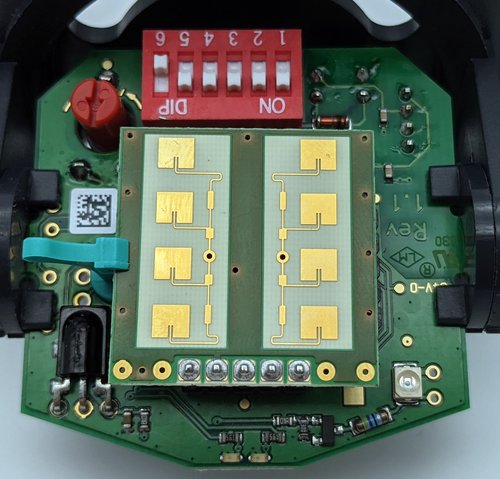

Steinel's HF 360 high-frequency sensor, for example, transmits at 5.8 GHz with no more than 1 mW, detects through glass, wood and stud walls, and can be hidden inside a fixture. Legrand notes the other side of that sensitivity: microwave detectors react to fans and running water, and can see movement beyond the area you meant to cover. Because a Doppler sensor measures motion toward or away from it, it complements PIR, which sees motion across its view best.
| PIR | Microwave (HF) | |
|---|---|---|
| Detects | Changes in infrared from warm bodies | Movement of anything, by Doppler radar |
| Best direction | Across the field of view | Toward or away from the sensor |
| Through glass | No | Yes, and through thin walls |
| Weather | Range changes with temperature | Unaffected by temperature |
| Emits | Nothing | A low-power 5.8 GHz signal |
| False triggers | Sun, heat vents, warm cars, pets | Branches, fans, running water, movement behind walls |
| Can be hidden | No: it needs a clear view | Yes, inside the fixture |
Setting time, sensitivity and light level
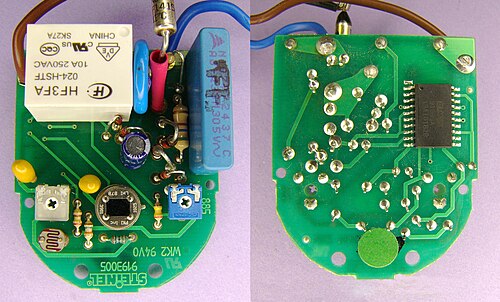
Most motion lights have three adjusters. TIME sets how long the light stays on after the last movement, from seconds to many minutes. SENS sets range. LUX sets how dark it must be before the sensor works at all, so set it toward night to keep the light off in daylight. Use test mode to aim it first.

- Set TEST, or the shortest time, and full sensitivity, then wait for the warm-up.
- Walk across the area at the distance you want covered, adjusting the head until the light responds where you want it to and not beyond.
- Turn sensitivity down if it sees the street, a sidewalk or a neighbor's yard.
- Set TIME: Eaton's HALO models go up to 12 minutes, and Hubbell's sensors from 2 seconds to 80 minutes.
- Set LUX. At its darkest setting a Hubbell sensor works only below about 10 lux.
False triggers and missed detections
False triggers come from anything that changes the infrared or moves within view: sunlight or headlights on the lens, heat vents, warm cars, pets, branches warmed by the sun, and passing traffic. Missed detections come from glass in the way, people walking straight toward the sensor, very slow movement, or a hot day that hides body heat.
| Problem | Likely cause | Fix |
|---|---|---|
| Turns on with nobody there | Pets and wildlife, branches, warm air from vents or dryers | Aim lower, reduce sensitivity, or mask the lens segments facing the source |
| Turns on when cars pass | Zones reach the street, or headlights hit the lens | Aim down; Hubbell advises keeping the view at least 20 ft from roads |
| Stays on | Constant motion in view, maximum time, or test or manual mode | Check the settings and look for moving or warm sources |
| Misses people | Glass in the way, a straight-on approach, too high, hot weather | Aim across the approach path and mount at 8–12 ft |
| Comes on in daylight | LUX set toward daylight, or the sensor is in deep shade | Turn LUX toward night |
Why LEDs glow or flicker on motion sensors
Two-wire motion sensors, which replace a switch and have no neutral wire, power themselves by leaking a small current through the light. An incandescent filament ignores it, but an LED driver stores it and releases it as a faint glow or periodic flash. A sensor with a neutral connection, or a load capacitor across the light, cures it.
Some two-wire sensors also need a minimum load, such as 25 W of LED, to work reliably. Load-correction devices such as Lutron's LUT-MLC or Clipsal's 31CAP connect across the lamp and give the leakage current a path around the LED driver. Motion floodlights rarely have the problem, because they are wired to both line and neutral and switch their own lamps. Illuminated and smart switches without a neutral cause the same glow; the LED driver guide covers the fixes.
Frequently asked questions
Why does my motion sensor light stay on?
Something in view keeps moving or changing temperature, such as branches, a vent or traffic, or the time is set to maximum. Some lights also have a test or manual-on mode. Re-aim the sensor, lower its sensitivity or shorten its time.
Why does my motion light turn on by itself at night?
Usually a small animal, branches moving in the wind, warm air from a vent or dryer, or headlights sweeping the lens. Aim the sensor lower and away from roads and vents, and turn the sensitivity down.
Can a motion sensor see through a window?
A PIR sensor cannot: glass blocks the far infrared it detects, so a sensor behind a window sees only the glass. Microwave sensors can see through glass and thin walls.
Do motion sensors work in cold weather?
Yes. PIR sensors see people better in the cold, because a body stands out more against a cold background. Heat is harder for them: on hot days their range shrinks.
Can pets set off motion lights?
Yes. A cat or dog gives off infrared much like a person, so to the sensor it looks like a small person. Reducing sensitivity is the main remedy, because a small animal gives a weaker signal than a person at the same distance.
Sources and further reading
- Panasonic Industry, PaPIRs pyroelectric infrared motion sensors: catalog and technical notes on detection range and temperature.
- Excelitas Technologies, dual-element pyroelectric detectors: data sheets and application notes.
- Eaton (Cooper Lighting), HALO motion-sensor floodlight installation instructions.
- Hubbell Lighting, motion-sensor floodlight installation instructions.
- Steinel, HF 360 high-frequency sensor data sheet.
- Legrand, "PIR and microwave detectors compared".
- Rayzeek, two-wire motion sensor minimum-load notes; Lutron, LUT-MLC load-correction device; Clipsal, 31CAP.
- Peak wavelengths: Wien's displacement law, λmax = 2898 µm·K ÷ temperature.
Image credits
- LED floodlight with sensor: Raimond Spekking, CC BY-SA 4.0. Fresnel lens: Jack LaRosa, public domain. Radar sensor board: Bawlsyrup, CC BY-SA 4.0. PIR controller board: Tympanus, CC BY-SA 4.0. All via Wikimedia Commons. Zone diagram: LEDlights.org.